




Most ecommerce brands have spent years building their search strategy around one idea: rank higher, get found, drive traffic. It's worked. For a lot of brands, it still does.
But the way a significant portion of your customers find products has changed, and it didn't happen gradually. According to Adobe's analysis of over one trillion visits to US retail sites, traffic from generative AI sources to ecommerce stores grew by 4,700% year-on-year in July 2025. According to Shopify's own research, nearly 60% of shoppers are now turning to ChatGPT or Gemini to help them make purchase decisions, even when the store they're browsing has its own AI tools built in. They're not waiting to be guided. They're going straight to AI for the answer. These aren't early adopters. This is the mainstream, shifting in real time.
Millions of people now skip the search results page entirely. They ask ChatGPT which protein powder is worth buying. They let Google's AI Overview tell them the best running shoes for flat feet before they've clicked a single link. They get a product recommendation from Perplexity and go straight to purchase from there.
If your brand isn't in that answer, you're not on page two. You're not in the conversation at all.
This shift has a name: Generative Engine Optimisation, or GEO. It's the practice of making your brand visible inside the answers that AI systems generate, not just the pages that search engines rank. And for Shopify brands that have invested seriously in SEO, it's the next thing you need to be thinking about.
What Is Generative Engine Optimisation (GEO)?
GEO is the process of structuring and presenting your brand's content so that AI-powered platforms, including ChatGPT, Google AI Overviews, Perplexity, and Bing Copilot, are more likely to reference or recommend you in their responses.
The term gained academic weight in 2024 when researchers from Princeton University and Georgia Tech published a paper titled "GEO: Generative Engine Optimization." The study examined how content characteristics influence visibility within AI-generated search results and found that specific optimisation strategies, including citing authoritative sources, adding statistics, and structuring content clearly, could increase a page's visibility in generative engines by up to 40%.
Just as SEO helps your pages rank in Google's traditional results, GEO helps your brand appear in the answers that AI systems generate. When a potential customer asks an AI assistant "what are the best running shoes for flat feet?" or "which Shopify stores sell sustainable clothing?", you want your brand in that answer.
Why GEO Matters for Ecommerce Brands
ChatGPT now has over 400 million weekly active users. Google's AI Overviews appear on a significant and growing share of search queries, and Google's AI mode is used by 75 million people monthly, per Search Engines Roundtable article. Perplexity is growing rapidly as an AI-native search engine. Microsoft's Copilot is built into Bing and the broader Microsoft ecosystem.
These aren't experimental tools any more. They're where a meaningful portion of product research now happens, and they're reshaping the economics of search traffic.
The zero-click problem is getting worse too. AI Overviews and chatbot responses often give users exactly what they need without requiring them to click anywhere. Research from SparkToro and Datos (2024) shows this is already driving a measurable drop in clicks to websites. If an AI names your competitor instead of you, there's no page two to fall back on.
We are already seeing a drop in clicks to websites:
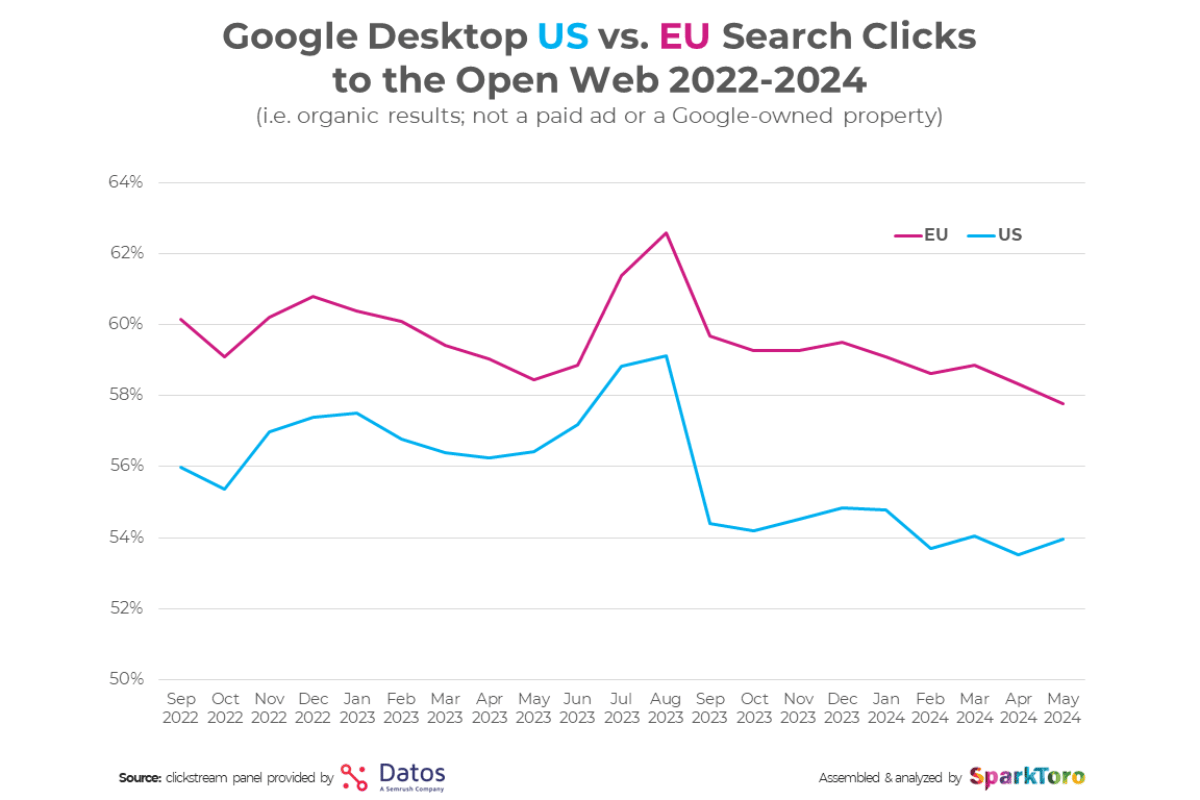
Source: SparkToro/Datos 2024 Zero-Click Search Study, via Search Engine Roundtable.
What makes this particularly significant for ecommerce is purchase intent. People asking AI assistants for product recommendations are typically close to buying. They're not browsing aimlessly; they're asking for specific guidance. Being recommended at that stage of the buyer's journey is worth more than most top-of-funnel traffic.
GEO is also still a relatively new discipline. Most ecommerce brands haven't heard of it, let alone started optimising for it. The window to build a position before your competitors catch on won't stay open for long.
How GEO Differs from Traditional SEO
SEO and GEO share the same fundamental goal: getting your brand found by people searching online. But the mechanics are meaningfully different.
Traditional SEO targets ranking factors to earn a position on a search engine results page. You're competing for one of ten organic spots on page one. GEO targets the AI models that synthesise information from multiple sources to generate a single conversational answer. There's no "ranking" in the traditional sense. The AI either mentions your brand or it doesn't.
What counts as a signal is broader too. Google's traditional algorithm evaluates backlinks, keyword relevance, and technical health. AI models draw from a wider set of inputs: your website content, third-party reviews, news mentions, structured data, and the consistency of your brand information across the web. In a sense, they're doing what a savvy consumer does before making a purchase, checking credibility across multiple trusted sources.
Content format also matters more than many brands realise. AI systems favour content that is clearly structured, factually specific, and easy to parse. Vague marketing copy that reads fine on a landing page often gets ignored entirely. AI systems want concrete information: materials, dimensions, use cases, comparisons, specifications.
One thing GEO does not do is replace SEO. It builds on it. A strong SEO foundation makes GEO significantly easier, and many GEO strategies simultaneously improve traditional search performance. We'll come back to this.
How AI Search Engines Work
Before you can optimise for AI search, you need to understand that these platforms don't all work the same way. How they find, process, and surface content varies, and that affects what you should prioritise for each.
ChatGPT (with Browse and Search) can browse the web in real time alongside drawing on its training data. When a user asks a product question, it synthesises information from multiple sources, prioritising content that is authoritative, well-structured, and directly relevant. Critically, it cites sources when browsing, which makes earning those citations a concrete and measurable goal for ecommerce brands.
Google AI Overviews pull from Google's existing index, which means your traditional SEO work still has direct influence here. The AI favours content that answers the query clearly and directly, uses structured data, and comes from trusted domains. If you're already ranking well organically, you're better placed than most to appear in Overviews.
Perplexity crawls the web in real time and provides answers with inline citations. For ecommerce specifically, it's one of the most commercially valuable platforms to optimise for: it frequently recommends individual products, surfaces specific brands by name, and links directly to purchase sources. A customer using Perplexity to research a purchase is often a step away from buying.
Microsoft's Copilot draws from Bing's index and runs on OpenAI's models, functioning similarly to Google's AI Overviews. Most brands neglect Bing optimisation entirely, which means there's often less competition in Copilot results. That's an opportunity worth taking seriously.
How AI Chooses Which Brands to Recommend
There are a handful of factors that consistently influence whether AI platforms recommend your brand.
Authority comes first. AI models assess whether your brand is recognised as a credible source in your space, influenced by backlinks, media coverage, brand mentions (both linked and unlinked), and the depth of your content. A brand that publishes comprehensive buying guides is more likely to be cited than one with thin product pages. In a way they are doing the searches and thought processes that a human would do, i.e. check if a brand is credible by checking reviews/social proofing across a variety of trusted platforms.
Clarity matters too. AI systems parse your content to extract relevant information, and content that is logically structured with descriptive headings is significantly easier to process. Ambiguous or overly creative copy can confuse these systems in ways it wouldn't confuse a human reader.
Structured data gives AI systems explicit, machine-readable information about your brand and products. Schema markup, particularly for Products, FAQs, Reviews, and your Organisation, is one of the most directly actionable GEO strategies available.
Consistency is also a factor that's easy to underestimate. AI models cross-reference brand information across multiple sources. If your product descriptions, pricing, and key claims are consistent across your website, Google Business Profile, social channels, and third-party platforms, the AI is more confident in recommending you. Inconsistency creates doubt.
Finally, recency matters. A product guide published last month is more likely to be cited than one from three years ago. Keeping your content fresh and your product information current is a meaningful edge.
6 GEO Strategies for Ecommerce Brands
1. Implement Comprehensive Structured Data
Structured data is the foundation of GEO for ecommerce. At minimum, you should have Product schema on every product page (covering name, description, price, availability, brand, reviews, and images), FAQ schema on relevant pages, Review and AggregateRating schema for products with customer reviews, Organisation schema on your homepage, BreadcrumbList schema for site navigation, and Article schema on blog content.
For Shopify stores, some of this can be handled through your theme or apps, but a thorough implementation usually requires custom work. Our free Shopify SEO audit covers structured data as a core component.
2. Create Authoritative, In-Depth Content
AI models favour content that demonstrates genuine expertise. For ecommerce brands this means buying guides that compare products honestly and in detail, how-to content that helps customers use your products effectively, and category-level content that establishes your authority in your niche.
The content needs to be genuinely useful. AI models are remarkably good at distinguishing between content written for people and content written to game a system.
3. Build Brand Mentions and Earn Press Coverage
The more frequently your brand is mentioned across credible third-party sources, the more likely AI models are to recognise and recommend you. Digital PR, getting your brand featured in relevant publications and roundups, is particularly valuable here, as are expert commentary placements, industry partnerships, and awards or certifications that create additional brand signals.
This is one of the areas where GEO and traditional off-page SEO overlap most directly.
4. Write Clear, Specific Product Descriptions
Vague product descriptions are a missed opportunity in AI search. Instead of "our premium leather shoes are crafted with care," give the AI something to work with: "full-grain Italian calf leather upper, Goodyear welted construction, leather sole with rubber heel insert, available in UK sizes 6 to 12 including half sizes."
AI systems make recommendations based on how well your product matches a user's query. If your descriptions don't contain the specific information being asked about, you're relying on other sources to describe your own products.
5. Build Out Your FAQ Content
FAQ content serves double duty in GEO. It directly answers the types of questions people ask AI assistants, and FAQ schema markup makes that content explicitly available to AI systems. Build FAQ sections for individual product pages, category pages, your main FAQ page, and blog posts.
The questions should reflect what real customers actually ask, not what sounds logical in a boardroom. Your customer service inbox, your product reviews, and Google's "People Also Ask" results are all good places to find them.
6. Prioritise Reviews and Social Proof
Customer reviews are among the most influential signals in AI recommendations. AI models use them to assess product quality, customer satisfaction, and relevance to specific use cases. Actively collect reviews through post-purchase email flows, respond to them (positive and negative), implement Review schema markup, and syndicate reviews across platforms including Google, Trustpilot, and your own site. Encourage detailed reviews that mention specific product attributes rather than generic praise.
Technical Implementation
Beyond content and strategy, the technical foundations matter. Use JSON-LD format for all structured data and validate your markup using Google's Rich Results Test. A clean, logical site architecture helps AI systems understand the relationship between your content, and accurate schema matters too: incorrect pricing or availability information can actively damage trust signals. Google's AI Overviews draw from Google's index, so Core Web Vitals and technical site health remain relevant. Ensure AI crawlers can access your content by checking your robots.txt for unintended blocks, and submit comprehensive XML sitemaps. HTTPS is a baseline requirement.
How GEO and SEO Work Together
These aren't competing strategies. Structured data improves both rich snippet eligibility and AI parsing. Authoritative content earns traditional rankings and AI citations. Brand mentions and PR build backlinks for SEO while also strengthening the brand signals that AI models rely on. A technically sound site supports both Google indexing and AI Overview inclusion.
The most effective approach is to build a strong SEO foundation and layer GEO-specific thinking on top. If your site already ranks well for relevant terms, you're already in a stronger position than most for AI search visibility. If your SEO foundations still need work, our Shopify SEO experts can help you build the kind of authoritative, well-structured presence that supports both traditional rankings and AI search visibility.
What Eastside Does for GEO Clients
As a Platinum Shopify Partner with over 500 stores built, we help ecommerce brands navigate the shift to AI search. Our work covers structured data audits and implementation across Shopify stores, content strategy that performs in both traditional and AI search, the technical SEO foundation that supports all search visibility, and ongoing monitoring of AI search visibility alongside traditional rankings.
We've worked with brands including Wild Deodorant, Oliver Sweeney, Origin Coffee, and Holland Cooper to build search strategies that drive measurable results. GEO is now part of how we think about search for every client we work with.
If you'd like to understand where your brand stands in AI search, get in touch for a conversation about your GEO and SEO strategy.
Frequently Asked Questions
What does GEO stand for?
GEO stands for Generative Engine Optimisation: the practice of optimising your brand's online presence so that AI-powered search engines, such as ChatGPT, Google AI Overviews, and Perplexity, are more likely to recommend you in their generated responses.
Is GEO the same as SEO?
No, though they're closely related. SEO focuses on ranking in traditional search results. GEO focuses on being referenced in AI-generated answers. Many strategies support both, but GEO places greater emphasis on structured data, brand authority across the web, and content clarity.
Does GEO replace SEO?
No. GEO builds on a strong SEO foundation. Traditional search still drives the majority of ecommerce traffic, and many GEO strategies improve your SEO performance as a byproduct.
How do I know if my brand appears in AI search results?
The most reliable approach right now is manual monitoring: regularly search for relevant queries in ChatGPT, Perplexity, Google (for AI Overviews), and Bing Copilot. Dedicated GEO tracking tools are beginning to emerge and we expect the tooling in this space to develop quickly.
What's the most important GEO strategy for ecommerce?
Structured data is the single most impactful starting point for most ecommerce brands. Comprehensive Product, FAQ, and Review schema gives AI systems the explicit, machine-readable information they need to confidently recommend your products.
How long does GEO take to show results?
Google AI Overviews can reflect changes relatively quickly, on similar timescales to traditional SEO. ChatGPT's training data has a lag, though its browse feature uses real-time information. Perplexity crawls in real time. As a general rule, expect to see initial movement within two to four months.
Can smaller ecommerce brands benefit from GEO?
Yes, often significantly. Smaller brands with strong niche authority can perform particularly well in AI search. AI models frequently recommend specialist brands when they demonstrate clear expertise and have positive reviews in a specific category.