



While expanding into new markets as an ecommerce business is an exciting prospect, it comes with new SEO challenges, especially when your website needs to now serve multiple different languages or regions. For ecommerce brands using Shopify, getting international SEO done correctly is essential to ensure the right customers land on the right version of your website.
One of the most important tools for managing multilingual and multiple regional websites is hreflang tags. These tags help search engines understand which language or regional version of a page should appear in the SERP, which helps prevent duplicated content and improves the experiences for customers wherever they are.
Understanding how hreflang tags work doesn’t require technical knowledge, but a clear implementation plan is needed to ensure the process is done correctly. In this guide, we’ll break down how to add Hreflang tags to your Shopify store and explain how they support international SEO, domains, and URLs.
What is Hreflang?
Hreflang is an HTML attribute that tells search engines when a page has alternate versions intended for different language or regional audiences. It is part of a broader set of implementation methods that also includes XML sitemaps and HTTP headers, all of which serve the same purpose: to help search engines correctly serve the right version of a page to the right user.
The most common implementation is an HTML tag placed on each page that has alternate versions. Here's an example from Gymshark.
< link rel="alternate" href="https://www.gymshark.com/" hreflang="en-us" />
This hreflang tag is found on the UK Gymshark homepage “https://uk.gymshark.com/”. It tells search engines that the USA version of this page can be found at “https://www.gymshark.com/”.
The hreflang tag contains two key attributes:
1 - Href The href is a link to the alternate page. It has to be the full URL address, and it must be a working page. It tells search engines “this is an alternate version of the page currently being viewed." ”.
2 - Hreflang The hreflang attribute contains the language code (ISO 639-1) and optionally the country code (ISO 3166-1) of the alternate page's target audience. The country code is optional, but the language code is a requirement.
Some examples of hreflang attributes using different language/country targeting combinations:
- en - English speakers
- en-GB - English speakers in the UK
- fr-FR - French speakers in France
- en-US - English speakers in the US
- it - Italian speakers
- it-CH – Italian speakers in Switzerland
Piecing the ‘href’ and the ‘hreflang’ together, search engines will know that this alternate URL (the href) is meant for this specific audience (the hreflang).
Do You Need to Add Hreflang?
You only need to add hreflang tags when you have two near-identical pages that serve different language/regional audiences. If there is no alternate version of a page, you don’t need to add hreflang tags.
Hreflang Rules
For hreflang tags to validate, they must follow specific rules:
1 - Return Links - If a page has hreflang links to an alternate page, the alternate page must have hreflang links back to the first page. For example, if a UK Gymshark has an hreflang link pointing at a German Gymshark page, the German page must have an hreflang link back to the UK version.
2 - Working Pages - Any page you hreflang link to must return a 200 status code. In other words, hreflang links have to be working pages.
3 - Self-Referencing Hreflang Tag - Any page which includes hreflang links must also have an hreflang link to itself. We call this a self-referencing hreflang link. The self-referencing hreflang link has to include the standard language/country declaration.
Understanding Hreflang Tags For Multilingual and Multiregional Shopify Stores
When managing a Shopify store that is both multilingual and multiregional, you need to implement hreflang tags. Hreflang tags are an essential part of your Shopify store’s SEO success and are a piece of HTML code that tells search engines about the different language versions of your website and the different regions that it is targeting. This ensures that search engines serve the right version of your website to users based on their language and location.
Here is a basic overview of the differences between hreflang tags for multilingual and multiregional Shopify stores:
1. Multilingual Shopify Store (Different Languages)
In a multilingual store, you offer the same content in different languages. For example, if you have an English and a French version of your site, you would use hreflang tags to specify the language version of each page.
Example Tags for a Multilingual Store (Languages Only):
< llink rel="alternate" href="https://www.example.com/en/" hreflang="en" />
< link rel="alternate" href="https://www.example.com/fr/" hreflang="fr" />
< link rel="alternate" href="https://www.example.com/es/" hreflang="es" />
2. Multiregional Shopify Store (Different Regions)
In a multiregional store, you offer the same content but optimised for different countries or regions (even in the same language). For example, if you offer an English version of your store for both the US and UK, you would use hreflang tags to specify the regional version.
Example Tags for a Multiregional Store (Regions Only):
- link rel="alternate" href="https://www.example.com/us/" hreflang="en-us"
- link rel="alternate" href="https://www.example.com/uk/" hreflang="en-gb"
- link rel="alternate" href="https://www.example.com/ca/" hreflang="en-ca"
- en-us: English (United States) en-gb: English (United Kingdom) en-ca: English (Canada)
The Importance of Hreflang in International SEO for Shopify
Expanding a website internationally brings various SEO challenges which can negatively impact how well your site performs in different regions if they are not addressed. By implementing the hreflang attribute on your website, you can ensure that the right version of the webpage is shown to users based on their language and region.
Shopify international SEO requires more than just translating your store. To properly target different countries and languages, you need a combination of Shopify Markets, international domain structures (subfolders, subdomains, or ccTLDs), and correct hreflang implementation.
Here are the key benefits of using hreflang for international SEO:
1. Improved user experience
When users are directed to the correct version of your store (both language and currency), it enhances their shopping experience. They’re more likely to engage, trust the store, and complete purchases if the content is in their native language and the pricing matches their local currency or region.
2. Reduced duplicate content issues
By having hreflang tags on your Shopify store, it indicates to search engines that different versions of a page are for different languages or regions. If hreflang tags are not implemented correctly, search engines like Google may consider different language or regional versions of the same content as duplicates. This can negatively affect your rankings.
3. Enhanced search engine results
By having the correct hreflang tags, it helps search engines provide the most relevant version of a page to users in their specific region and improves your Shopify store's visibility in different countries. By indicating the correct language and country for each page, your store is more likely to rank higher in localised search results, driving more targeted traffic from international markets.
4. Boosts visibility in local search results
Fixing hreflang issues ensures your store is properly set up for targeted international marketing campaigns. When users arrive at the correct localised version, it increases the effectiveness of your campaigns, whether you’re advertising in different languages or offering region-specific promotions.
5. Increases targeted traffic
Using hreflang tags can also help drive localised audiences to the appropriate regional webpage versions of your site, which boosts conversions and user satisfaction. Fixing hreflang issues ensures that customers see content in their language and tailored to their region, improving engagement and conversion rates.
6. Prevents wrong page indexing
Hreflang tags are a useful way to ensure that search engines index the correct version of a page for a specific language or region.
7. Improves your international SEO strategy
Hreflang tags help search engines like Google understand which version of your site should be displayed to users based on their language or geographic location. This helps to improve your SEO performance across different markets and achieve better rankings by region and language.
8. Support for multinational and multilingual sites
Using the correct hreflang tags makes it easier to expand into new markets, as search engines immediately recognise and serve the appropriate version to users in those new markets. This ensures that the correct language or regional version of your Shopify store appears in search results, improving your SEO performance across different markets.
9. Enhanced trust and credibility with users who can find content tailored to their language and cultural context
Showing customers the correct language and regional version builds trust. Users are more likely to purchase from stores that cater specifically to their needs, including language and currency preferences. A smooth, localised experience reflects positively on your brand.
Using the hreflang tool correctly is extremely critical, as this can significantly improve the impact of your international SEO Shopify strategy and ensure that your users have the best possible experience. Search engines are also able to understand and rank you.
How to implement hreflang tags on Shopify
Correctly implementing hreflang tags ensures that search engines show the right page version to users based on their language or location. Shopify provides some built-in internationalisation features, but implementing these tags correctly requires some key configuration steps.
Below is a straightforward example of managing hreflang tags on Shopify.
Understanding How Shopify Handles International URLs
Before adding hreflang tags, it’s important to understand how Shopify structures international URLs. This is typically done with one of three approaches:
- Country-specific domains
- Subdomains
- Subfolders
Each version represents a different language or regional market, and the hreflang tags connect these versions so search engines understand they are alternatives rather than duplicate pages. From an SEO perspective, ensuring that your international domains and URLs are properly structured makes hreflang implementation far more effective.
Enable Shopify Markets For International Stores
Shopify’s Market features are the foundation of most international setups. To configure this:
1. Log into your Shopify admin dashboard
2. Navigate to Settings > Markets
3. Add the countries or regions you want to target
4. Assign the appropriate domain, subdomain or subfolder for each country
5. Configure the currency and language settings
When Shopify markets are configured correctly, Shopify will automatically generate some hreflang signals between international versions of your store. However, depending on your setup, additional manual validation or adjustments may still be needed.
Verify Your Hreflang Tags in the Theme Code
For a deeper explanation of how hreflang works in practice and how Google interprets international site signals, Google Search Central provides an official walkthrough of international SEO and hreflang implementation.
Implement an x-default tag
An x-default hreflang tag tells search engines which versions of the page to show them when no language or region match is found. For international Shopify stores, this is usually the main global homepage.
< link rel="alternate" href="domain" hreflang="x-default" />
Including this tag helps to improve how Google routes international users who may not match a specific country or language configuration.
Validate Your Hreflang Tag Implementation
Once your hreflang tags are in place, validation is critical, as incorrect implementation can prevent search engines from interpreting your international pages correctly. Some key checks to include are:
- Ensure each page references every alternative version
- Confirm Hreflang tags are reciprocal between pages
- Verify that international URLs match the correct language version
- Check that no broken links or redirects are used in the tags
To validate, you can use the following SEO tools:
- Google Search Console
- Crawling tools such as Screaming Frog
- International SEO audit tools such as Moz and SemRush
Regular monitoring ensures that your Shopify hreflang implementation continues working as your store expands into new markets.
The Challenges of Implementing Hreflang Tags in Shopify
Be Careful of Shopify Markets Auto Tags
One of the biggest challenges when implementing hreflang on Shopify is that Shopify Markets can automatically generate these for you. While this might sound helpful, it can quickly create conflicts if you’re also manually adding hreflang tags, using an SEO app or customising themes or liquid files.
This often results in:
- Duplicate tags
- Conflicting language or regional signals
- Incorrect URLS being redirected
The issue is that Shopify auto-generated tags are not always fully aligned with your intended SEO strategy, particularly if you’re targeting:
- Multiple domains vs subdomains
- Specific country and language combinations
- Custom canonical structures
So, before implementing anything manually, always make sure that you audit what Shopify Markets is already doing. In many cases, less intervention is better to avoid duplication and confusion for search engines.
Auto Redirects Between Regional Sites
Shopify Markets also enables automatic redirection based on a user’s location, which can interfere with hreflang implementation. Ge-redirects can improve user experience; however, they can also create SEO issues, such as:
- Blocked search engines access to alternative regional URLS
- Googlebot restrictions (for example only seeing one version of your site)
- Hreflang tag effectiveness due to crawl impact
For example (this could be in a box/visual)
- When a users (or bot) lands on your .com site
- They are automatically redirected to .co.uk
- Google may struggle to properly index both versions of your site
For best results:
- Avoid hard redirects based purely on IP addresses
- Use soft prompts such as location banners
- Ensure all regional versions of your site remain accessible for crawling
Hreflang relies on accessibility, so if bots can’t reach your alternative pages, your implementation won’t work as intended.
Hreflang and Canonical Tags
Another common pitfall is the relationship between hreflang tags and canonical tags. For hreflang to work properly:
- Each regional page must have a self-referencing canonical tag
- Pages should not canonicalise to a different region
One common mistake when using Shopify is all regional pages canonicalising back to a primary domain. This sends conflicting signals, meaning that the canonical tag says this is the main version, and hreflang says there are alternative versions. As a result, search engines might ignore the hreflang tag completely, fail to serve the correct regional page or consolidate rankings into one version.
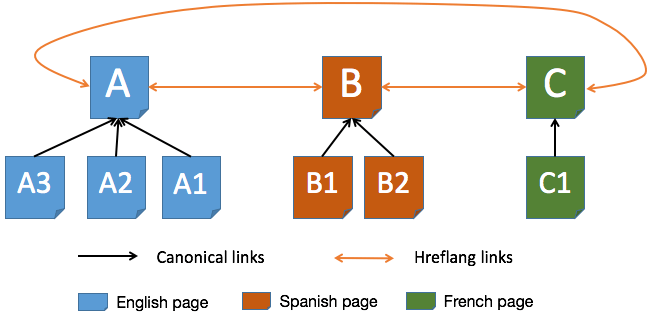
It’s key that hreflang and canonical tags work together, as misalignment is one of the most common causes of failed international SEO setups on Shopify.
Common hreflang mistakes and how to fix them
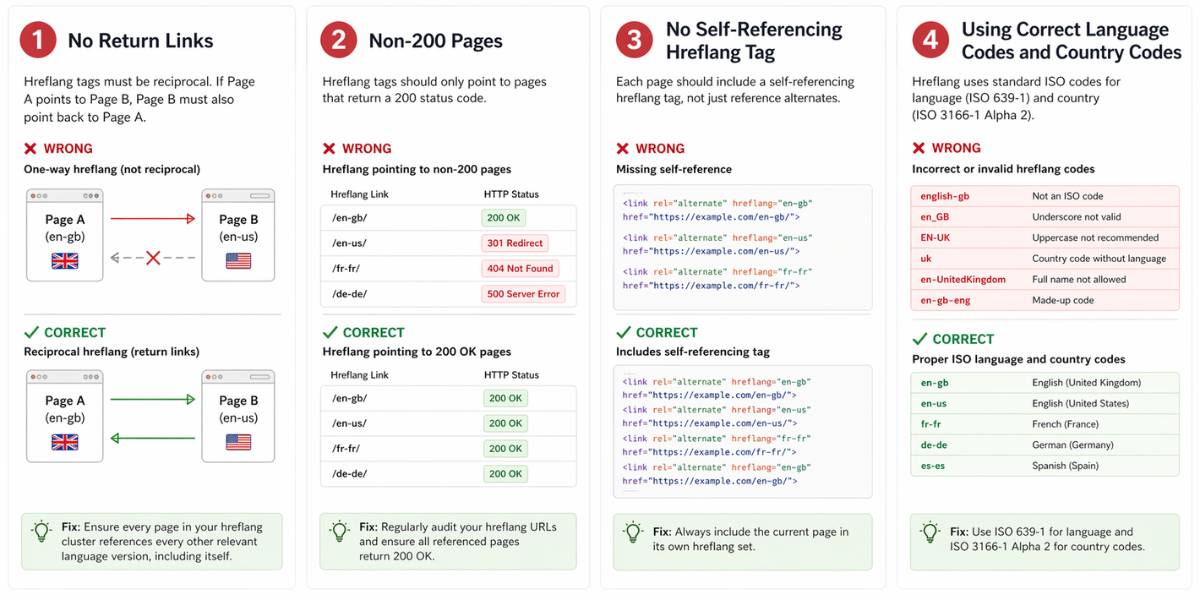
No Return Links
Hreflang tags must be reciprocal, meaning that if Page A points to Page B, then Page B must also point back to Page A. This is known as a return link, and without it, your hreflang implementation could break.
Common issues include:
- One-way hreflang annotations
- Missing references between certain regional pages
- Incomplete tagging across large site structures
Every page in your hreflang cluster must reference every other relevant language version, including itself; otherwise, search engines could ignore the whole setup.
Non-200 Pages
Hreflang tags should only point to pages that return a 200 status code. If your tags reference pages that are:
- 404 (not found)
- 301/302 (redirected)
- 500 (server errors)
This can create confusion for search engines and weaken your implementation. This is a common issue in Shopify when products go out of stock and/or are removed, URLs change, or redirects are added without updating the hreflang tags.
It’s best practice to regularly audit your hreflang URLs, ensure they resolve directly and keep all referenced pages live and accessible, as broken or redirected URLs can invalidate your setup.
No Self-Referencing Hreflang Tag
Each page on your site should include a self-referencing hreflang tag, not just reference alternate versions. This helps search engines understand the language and region of the current page and how it fits into the wider hreflang cluster.
Without a self-reference, the page may not be properly associated with its alternates, and signals become weaker, making them less reliable. It’s important to always include the current page in its own hreflang set. It’s a small detail, but it makes a big difference.
Using Correct Language Codes and Country Codes
Hreflang relies on standardised ISO codes, and getting these wrong is a common issue for Shopify merchants.
The correct format is:
- Language code (ISO 639-1)
- Optional country code (ISO 3166-1 Alpha 2)
For example:
- en-gb (English, United Kingdom)
- en-us (English, United States)
Common mistakes here include using correct or made-up codes, mixing the formats with full names instead of ISO codes, and applying country codes without language ones. This can cause hreflang tags to be ignored, incorrect regional targeting, and indexing inconsistencies.
How To Check Hreflang Tags
Hreflang Tag Checker
Using a dedicated hreflang tag checker is the fastest way to validate your international tagging on individual pages. These tools allow you to enter a URL and instantly see which hreflang tags are present and whether they’re correct or not. These checks are particularly useful for one-off needs or for smaller sites where a full crawl isn’t necessary. Many of these free online tools also highlight common issues, such as missing self-referencing tags or incorrect ISO language codes, allowing you to fix any issues before they affect your search visibility.
Screaming Frog
Screaming Frog is a robust tool for crawling your entire website and checking hreflang implementation at scale. After setting up a crawl, you can review the hreflang report to identify any errors, such as missing or incorrect tags, non-reciprocal links, or pages returning errors instead of a 200 status. Screaming Frog is the ideal tool for large sites because it gives a complete overview, allowing you to spot any site-wide inconsistencies and fix them efficiently.
Google Search Console
Google Search Console provides valuable insights at the URL level, using the URL inspection tool. With this tool you can check individual pages to see how Google interprets the hreflang tags, which helps verify if the search engine is able to read your intended language and regional signals. Errors such as missing self-referencing tags or invalid language codes will be highlighted, giving you a clear path to make optimisation decisions.
Ahrefs Site Audit
The Ahrefs site audit includes hreflang validation as part of its overall site health reports, so once a site audit is run, the international SEO section will flag issues such as missing reciprocal links or inconsistent sets. This tool is useful for ongoing monitoring and allows you to schedule regular audits and catch new errors as your website grows or content changes. It’s particularly useful for teams who want automated alerts to catch hreflang problems before they begin to impact rankings.
SEMrush Site Audit
The SEMrush site audit also identifies hreflang issues as part of its comprehensive SEO audit, highlighting common errors such as incorrect ISO codes, non-reciprocal tags, and conflicts between canonical and hreflang configurations. By integrating hreflang checks into regular SEMrush audits, you can maintain consistent international SEO standards and ensure each language or regional version of your site is targeted properly.
Different Ways To Add Hreflang
Implementing hreflang correctly is essential for international SEO practices, but there are multiple ways to do it depending on your website setup, platform, and technical skillset. Each method below has pros and cons, so understanding the options can help you choose the best approach that works best for your site and ensures search engines correctly serve content to the right audience.
XML Sitemap
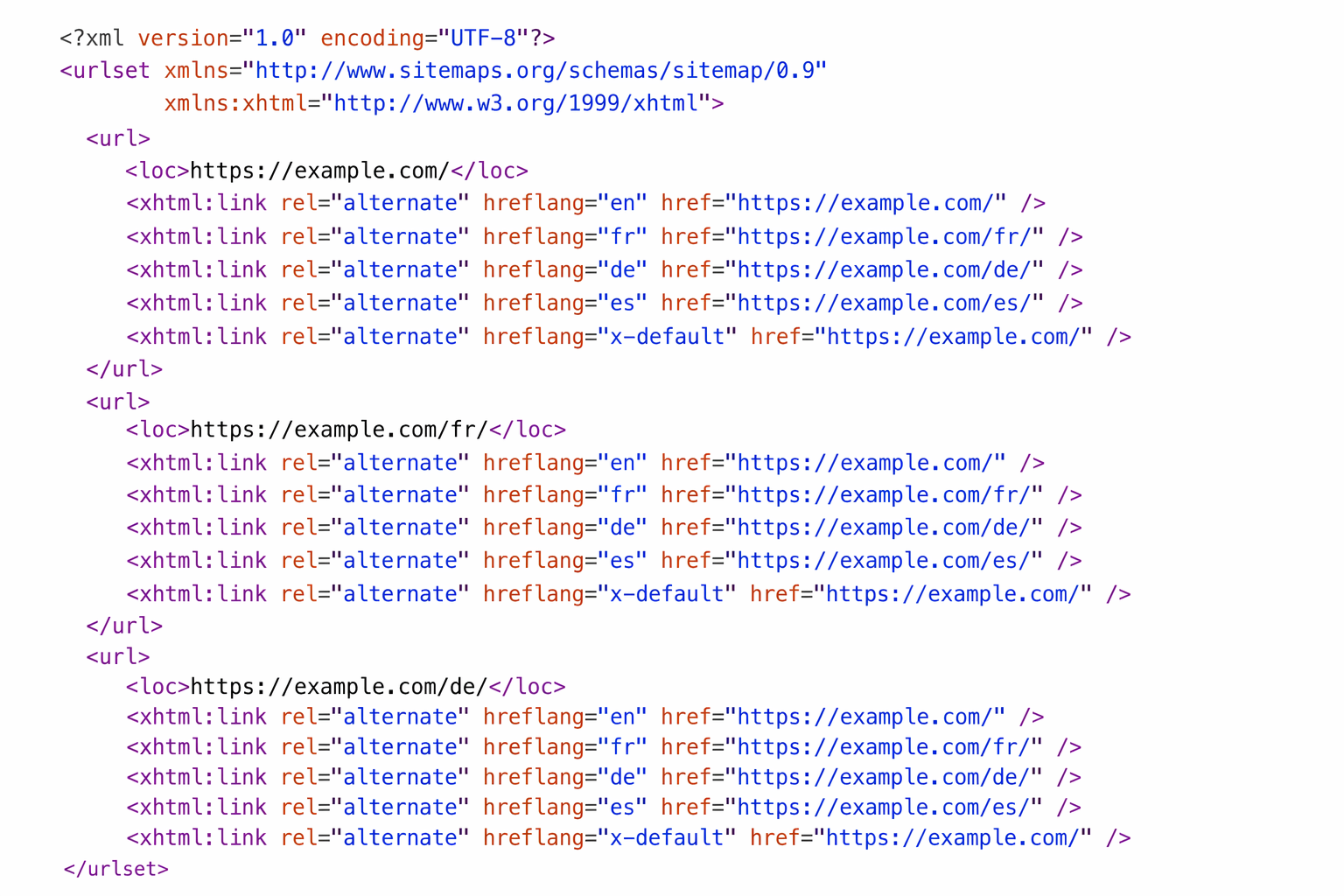
Adding hreflang to your XML sitemap is a scalable and relatively straightforward process to integrate language and regional targeting. Rather than embedding hreflang tags on every page of your site manually, you can include the following element in your sitemap for each URL variation:
< xhtml:link>
This is especially helpful for large websites with hundreds of thousands of pages, as it reduces the risk of missing or inconsistent tags. Some other things to remember are;
- Ensure each alternate language URL is included in the sitemap
- Use the correct rel=alternate and hreflang attributes
- Regularly update and submit the sitemap to Google Search Console
HTTP Headers
Hreflang via HTTP headers is a less common but equally useful method, particularly for non-HTML resources such as PDFs or dynamically generated pages where embedding tags in the page is not possible. By including Link headers in your HTTP response, you can specify alternate language or regional versions. For example, your server is returning headers like
- < https://example.com/en/>
- rel=”alternate”
- hreflang=”en”
This method is technically robust, but it requires server access and configuration knowledge, so it’s usually more suitable for developers and sites with a more complex setup. Our web development team can help with this.
Translation Apps Like Weglot and Langify
For ecommerce platforms or CMS-based websites, translation apps such as Weglot and Langify offer a user-friendly interface to implement hreflangs automatically. These tools handle both the translation and the insertion of hreflang tags for each language version you need.
For example, when you add a new language in Weglot, it automatically generates the correct hreflang tags on each page and can manage subdomains, subdirectories, or query parameter setups. This approach reduces the risk of manual errors and is ideal for merchants or content managers who want a mostly hands-free solution for multilingual SEO.
Google’s Future Plans for Hreflang
While manual hreflang tags remain the current standard for international SEO, Google’s long-term vision points toward a gradual shift in how language and regional targeting are handled by search engines. In the current ecommerce landscape, search engines are increasingly relying on AI and machine learning to detect language and regional variations automatically. This means that over time, websites may be able to achieve accurate localisation without manually annotating every page with hreflang tags.
For webmasters, this approach aims to reduce the technical burden of managing multilingual and multi-regional sites. While manual hreflang implementation will continue to be essential for now, the move toward automated language recognition suggests that future international SEO may become less dependent on exact technical markup.
Google has also been adjusting how it handles country-specific domains, redirecting many local versions (such as google.co.uk) to Google.com while still serving localised results to users. This change means that while your pages may continue ranking appropriately in each region, referral traffic from Google may appear differently in your analytics.
At the moment, site owners can continue to follow standard hreflang and localisation best practices without adjusting their technical approach, along with monitoring updates from Google as advancements in AI-driven detection gradually simplify how multilingual content is indexed and served globally.
Get in touch
If you’re managing a growing store or expanding into new markets, implementing and maintaining hreflang can quickly become a timely and complex task. At Eastside, we can support everything from multi-language Shopify builds and translation strategy to technical SEO and ongoing optimisation to help you scale your store internationally with confidence. Get in touch today!
Hreflang Tags FAQ
In this section, we’ll address the most common questions and concerns about hreflang, from why they matter to platform-specific considerations and how agencies approach multilingual web development.
Why are hreflang tags important?
Hreflang tags tell search engines which language and regional version of a page to serve to users. Without them, Google may show the wrong version of your site to visitors or even treat duplicate pages as separate content, which can dilute SEO value. Correct hreflang implementation ensures that users see the most relevant pages, improves engagement metrics, and protects your site from ranking issues caused by duplicated content in multiple languages.
Does hreflang solve duplicate content?
While hreflang helps search engines understand that similar pages are intended for different languages and regions, it does not eliminate duplicate content issues entirely. Pages still need to be unique where possible, and canonical tags should be used in conjunction with hreflang to indicate the primary version of a page. Essentially, hreflang tells Google, "These pages are variations, not duplicates," but good content practices should still be followed to ensure your strategy is well optimised.
What do I need to do differently for Bing?
Bing supports hreflang, but there are some differences compared to Google. For example, Bing relies heavily on correct ISO language codes and may not always interpret regional targeting as granularly as Google. Shopify site owners should verify that their hreflang tags are fully compliant with Bing’s syntax, ensure reciprocal links between page variations, and monitor Bing Webmaster Tools for any localisation warnings. This ensures that international pages perform well across all search engines, not just Google.
How does adding multiple languages to my Shopify store impact SEO?
Adding multiple languages to a Shopify store can significantly improve reach and engagement, but it also introduces more SEO complexities. Each language version must have the correct hreflang annotations and ideally unique content to avoid duplication issues. Shopify apps such as Weglot and Langify can automate this process by generating hreflang tags and managing subdirectories or subdomains. It’s also important to monitor your site’s speed and structured data for each language version to maintain consistency and overall SEO performance.
How do agencies handle multi-language website development?
Many agencies specialise in Shopify internationalisation, offering services such as multilingual website development, hreflang implementation, and localisation strategy.
When working with an agency, there will be a structured approach to multi-language web development. This includes planning URL structures (subdirectories vs. subdomains), ensuring that hreflangs are implemented correctly, coordinating translations, and testing across different devices and regions.
Agencies will also integrate hreflang checks into routine audits to prevent errors and maintain your site’s overall international SEO health. By working with an experienced partner, merchants can manage the technical and linguistic complexities of a multilingual website and scale efficiently without sacrificing performance.