




Type "what's the best organic skincare brand for sensitive skin" into ChatGPT and you'll get back a confident, three-paragraph answer with two or three named brands and reasons attached. The same query in Perplexity returns something similar, complete with citations. The decision about which brands to consider used to happen on a Google results page. Increasingly it's happening inside that kind of conversation, and by the time the customer reaches your website, if they reach it at all, the shortlist has already been built for them.
That's a meaningful change in how the top of the funnel actually works for ecommerce, and it sits awkwardly alongside most of the SEO advice still being handed out. The brands appearing in AI-generated answers aren't always the ones ranking highest in conventional search results, because the signals AI systems weigh, and the logic they use to assemble a recommendation, follow rules of their own. This guide is about what those rules look like in practice, and what to do about them on a Shopify store.
What's actually changed
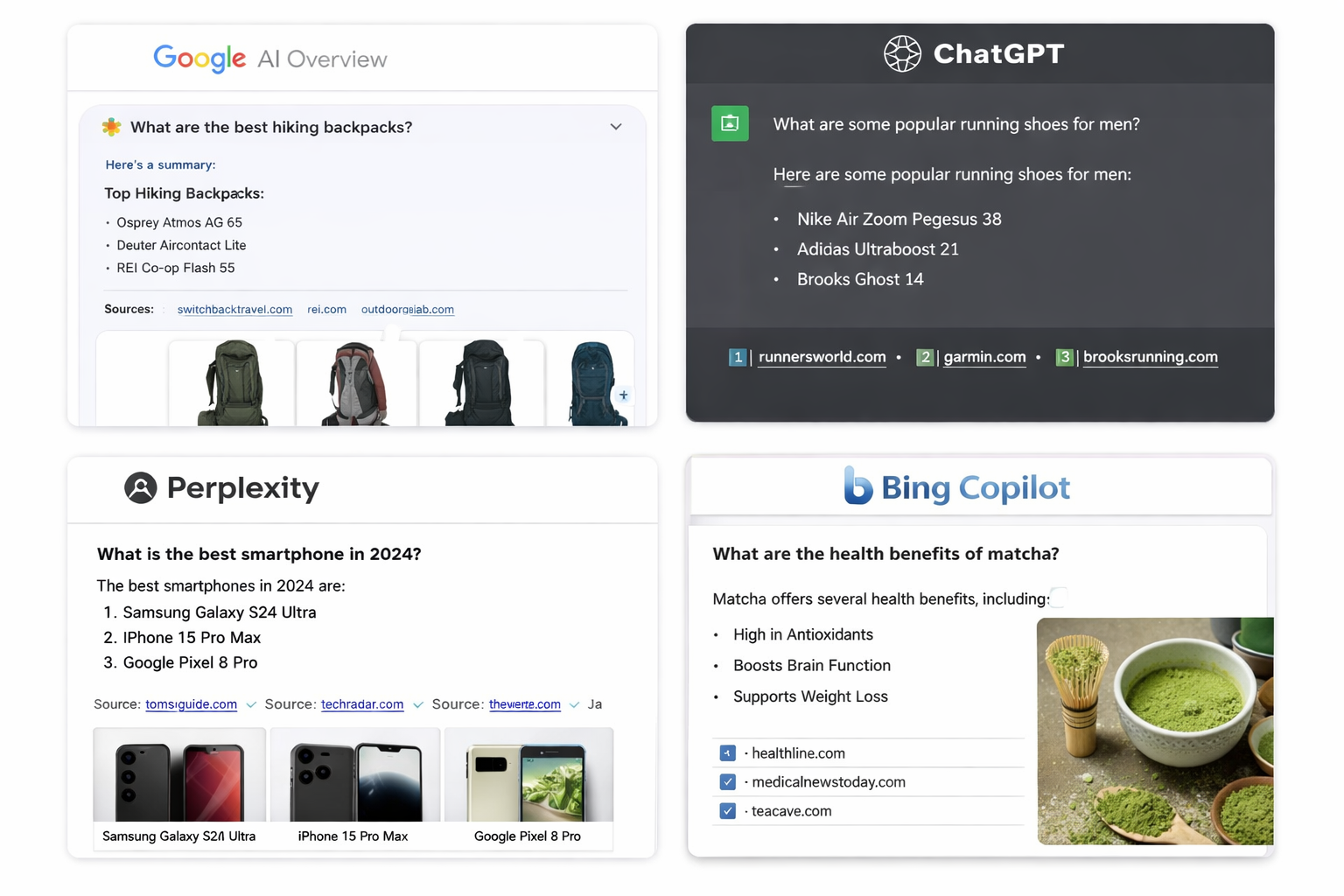
ChatGPT now sees over 400 million weekly users. Google has rolled AI Overviews into a significant share of search results, with a synthesised answer often appearing above the traditional links. Perplexity is becoming a serious destination for product research, and Bing Copilot is quietly embedded across Microsoft's ecosystem. For ecommerce, that means a real chunk of product discovery now happens inside a conversation rather than on a results page. Someone asks "what's the most comfortable work boot for warehouse staff" and gets an answer with three brand recommendations. If you're one of the three, that's traffic with serious purchase intent. If you're not, you've been left out of a conversation you didn't know was happening.
How the platforms work
Each platform sources its answers slightly differently, and that affects how you optimise.
Google AI Overviews pull directly from Google's existing index. Your traditional SEO performance feeds straight into AI visibility here. Google favours content that answers the query directly, demonstrates real expertise, and uses structured data well. A useful nuance: ranking on page one doesn't guarantee inclusion in the Overview. Google's AI may pull from sources further down the page if they explain the answer more clearly.
ChatGPT uses both its training data and live web browsing. It tends to recommend brands with consistent information across multiple sources and a strong online reputation. When it browses live, it cites sources, which means there's a referral traffic opportunity if you become one of those citations.
Perplexity crawls in real time and includes inline citations on every answer. It's strong on comparison and recommendation queries, and because it links out to its sources, it offers the clearest direct traffic opportunity of any AI search platform today.
Bing Copilot runs on OpenAI models and pulls from Bing's index. Most ecommerce brands ignore Bing entirely. That's the point. Less competition means easier wins.
Seven things to do about it
The list below is ordered by impact for a typical Shopify store. Some of these are quick wins. Others are longer plays. None are optional if AI visibility matters to you.
1. Implement comprehensive structured data
If you only do one thing on this list, do this. Structured data is how AI systems understand what your pages actually contain. Without it, they're guessing. With it, they have machine-readable facts about your products, your brand, and your content.
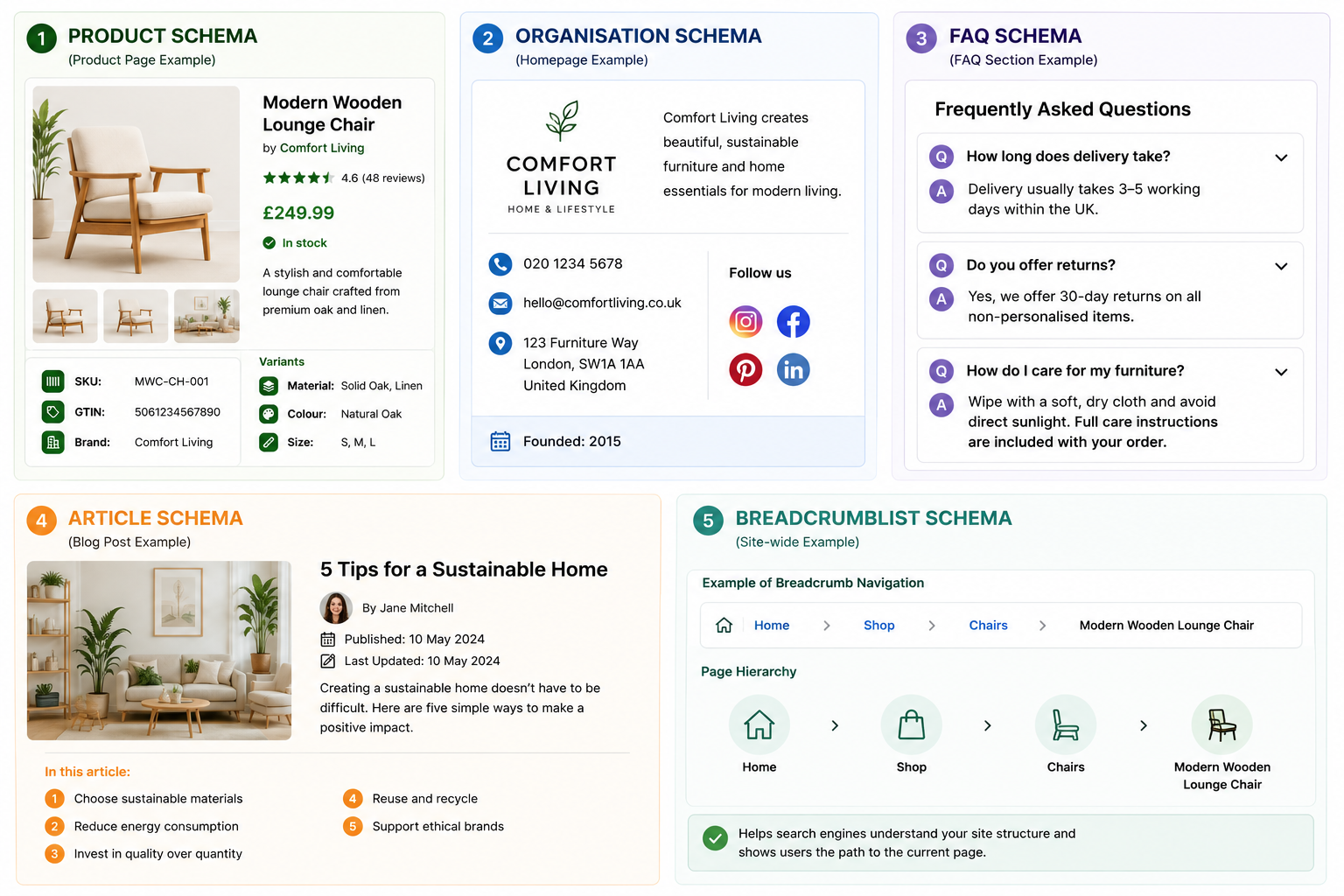
Most Shopify themes ship with basic Product schema, but it's rarely complete enough to compete. The schema you want in place includes:
Product schema on every product page, covering name, description, brand, price, availability, SKU, GTIN where applicable, AggregateRating from your reviews, images, and variant details like material, colour, and size.
Organisation schema on the homepage, with your business name, logo, contact information, social profiles, and founding details.
FAQ schema anywhere you have FAQ content, with each question and answer marked up correctly.
Article schema on blog posts, including author, dates, and article body.
BreadcrumbList schema site-wide, showing the navigation path for every page.
You've got a few implementation options. Custom Liquid gives you the most control and the cleanest output. Apps like JSON-LD for SEO can do most of the heavy lifting, though they're worth auditing because plugins occasionally get abandoned and stop receiving updates. For larger catalogues or stores with custom requirements, a professional implementation tends to pay back quickly.
Whichever route you take, validate everything. Google's Rich Results Test tells you whether your schema qualifies for enhanced features in search. Schema.org's validator confirms your markup is technically correct against the official spec. Both are free, and both should be part of your launch checklist.
2. Build topical authority through content
AI models don't just look at individual pages. They build a picture of whether your brand is a credible authority on a topic, and that picture comes from the breadth and depth of what you publish. For a Shopify store, that means going beyond product pages. The brands winning here have proper buying guides, comparison content that honestly evaluates options (yes, including competitors), educational posts that answer real questions in their space, and category pages that do more than list SKUs.
A topic cluster approach works well. Pick a core topic that matters to your customer, say "sustainable fashion," and build a deliberate cluster of related content around it. Each piece reinforces the others. Both traditional search engines and AI models pick up on this kind of structured expertise. The content has to be worth reading. AI models are sophisticated enough to spot thin, keyword-stuffed copy and to ignore it. One genuinely useful 2,000-word guide will do more for your visibility than ten shallow 500-word posts.
3. Earn citations from authoritative sources
When AI systems see your brand mentioned across credible sources, the signal compounds. You become a safer recommendation.
The citations that matter aren't directory listings. They're features in industry publications, expert quotes in journalism, inclusion in "best of" round-ups (which are heavily used as AI source material), academic or research mentions where relevant, and presence in knowledge bases like Wikipedia. On Wikipedia specifically: never edit your own entry. Earn the mention through genuine notability, or don't have one at all. One placement in a respected industry title is worth more than fifty mentions in low-quality directories. Concentrate your effort accordingly.
4. Invest in brand mentions and digital PR
Brand mentions matter even when they don't link back to you. AI models gauge your reputation partly by how often, and how positively, you appear across the web. The work here looks like proper digital PR. Newsworthy data campaigns, useful research, partnerships with complementary brands, awards entries, certifications displayed prominently on your site, and visible founders or team members who write, speak, and contribute commentary in your space. Social media presence feeds into this too, particularly when it's consistent and engaged.
Most of this overlaps with traditional off-page SEO, which is part of why AI search optimisation tends to reward brands that already take their broader marketing seriously.
5. Write product descriptions that give AI something to work with
AI systems need facts. Vague, mood-led product copy doesn't give them enough to make a recommendation, even when the product itself deserves one. That doesn't mean stripping personality out of your copy. It means making sure the factual layer is there alongside the brand voice. Materials and ingredients should be specific. Dimensions and weight should be exact. Features should be described clearly, not gestured at. Use cases, ideal customer profiles, care instructions, manufacturing origin, and proper sizing guidance with measurements all matter.
Here's the test. If a customer reading your description couldn't tell you what the product is made of, where it's made, or who it's for, an AI can't either.
6. Build FAQ content into the structure of your store
FAQ content mirrors how people actually use AI search. They ask a question. The AI looks for an answer. If your site is where that answer lives, you become the source.
The opportunity isn't just a single FAQ page. Product pages benefit from product-specific questions ("is this suitable for sensitive skin?", "what's the return window on sale items?"). Collection pages can answer category-level questions ("what's the difference between merino and cashmere?", "how do I size up?"). Blog posts can close with a short FAQ section relevant to the article topic. Your dedicated FAQ page handles brand, shipping, returns, and general queries. Mark all of it up with FAQ schema. Without the markup, the content is still useful. With it, you're explicitly handing AI systems a structured answer.
The best source for FAQ content isn't your imagination. It's your customer service inbox, your product reviews, and Google's "People Also Ask" results. Real questions, in the language customers actually use.
7. Strengthen your reviews and social proof
Reviews are one of the strongest signals an AI uses when deciding which brand to recommend. Detailed, positive reviews with specific product attributes carry serious weight.
A solid review programme has a few components working together. Automated post-purchase email flows that request reviews (most Shopify review apps support this out of the box). Prompts that encourage detailed feedback rather than star ratings alone. Visible responses to reviews, both positive and negative, which signal that you're engaged with your customer base. Review schema implemented properly, with both AggregateRating and individual Review markup. And syndication across Google, Trustpilot, and your own site, so the reputation signal compounds. Reviews also give your product pages something traditional SEO loves: fresh, unique, customer-generated content. The benefits stack across both AI and conventional search.
What gets in the way
A few common mistakes are worth flagging because they undermine everything else you do.
Blocking AI crawlers: Some brands block GPTBot, PerplexityBot, and similar in their robots.txt. There are legitimate reasons to consider this, mostly around content protection. The trade-off is that blocked crawlers can't include you in their answers. If AI search is a priority, the bots need access.
Ignoring Bing: Lots of Shopify stores treat Bing as an afterthought, which means missing the channel that feeds Bing Copilot. Less competition there is a feature, not a bug.
Thin product content: Stores with thousands of SKUs often have minimal copy on most of them. AI search rewards detail. Prioritise your bestsellers and highest-margin lines first, and work down from there.
Inconsistent brand information: If your business name, product names, pricing, or core claims differ between your site, Google Business Profile, social profiles, and third-party listings, AI models lose confidence. Audit your brand information across every platform that mentions you.
Skipping the technical foundations: AI search optimisation doesn't work on a broken site. Slow page speed, broken links, duplicate content, and poor mobile experience hurt you everywhere.
Measuring what's actually happening
Here's what works today.
Manual checks are still the most reliable method. Run your most important queries through ChatGPT, Perplexity, Google's AI Overviews, and Bing Copilot regularly. Note when and how your brand appears. It's slow, it's imperfect, but it tells you the most about real visibility.
Referral traffic shows up in Shopify analytics and GA4. Look for traffic from chat.openai.com, perplexity.ai, and bing.com. Tracking from AI platforms is patchy and not always accurate. Bing Webmaster Tools is the exception, with proper visibility into Copilot-driven traffic and citations.
Brand mention monitoring through tools like Google Alerts, Mention, or Brandwatch gives you a broader picture. A rise in quality mentions usually correlates with better AI visibility over time. Structured data validation should be a routine check, not a one-off. Use Google Search Console's enhancement reports to monitor schema health across the site at scale.
A handful of dedicated AI search tracking tools are starting to appear. The category is moving fast. Expect proper measurement infrastructure to mature over the next 12 to 18 months.
Where this is heading: agentic commerce
The interesting shift coming next isn't about AI recommending products. It's about AI buying them.
Agentic commerce is the term for AI agents that don't just suggest options but transact on behalf of their users. A customer tells their assistant "reorder my coffee, but try the dark roast this time," and the agent identifies the brand, finds the product, and completes the purchase. Early versions of this are already being tested.
For Shopify merchants, the implications are practical. Machine-readable product information stops being a nice-to-have and becomes the entire interface. Pricing and availability need to be consistent across every channel an agent might check. API accessibility and structured data effectively determine whether agents can interact with your store at all. Trust signals like reviews, return policies, and brand authority will shape which brands agents prefer.
The work you do now to make your store legible to AI search is the same work that prepares it for agentic commerce. Brands that build the foundations early will be the ones AI agents pick first.
Common questions
Do I need to change my Shopify theme to optimise for AI search?
Most likely not. The bulk of the work happens through structured data, content, and off-site activity, none of which require a theme change. If your current theme has weak technical foundations, that's a separate conversation worth having anyway, and one for our Shopify web development team to look at.
How quickly will I see results?
Perplexity crawls in real time, so changes can show up fast. Google AI Overviews follow your indexing speed. ChatGPT's training data has a lag, but its live browsing uses current data. Realistically, expect meaningful movement within two to four months of consistent work.
Should I block AI crawlers to protect my content?
It's a business decision rather than a technical one. Blocking keeps your content out of AI responses, which means you don't appear in those answers. For most ecommerce brands, the visibility upside outweighs the content protection concern.
Is this expensive to do well?
It doesn't have to be. Better product descriptions and proper FAQ content can be done with the team you already have. Comprehensive structured data and digital PR need more investment, though both pay back across AI and traditional search.
Can I do AI search optimisation without traditional SEO?
Technically yes, practically no. Traditional SEO is the foundation AI search builds on, particularly for Google AI Overviews, which pull from the same index. Skipping the SEO work makes everything else harder. If you're not sure where your store's foundations stand today, our free Shopify SEO audit is the right place to start.
Which platform should I prioritise first? Google AI Overviews and Perplexity are the two to start with. Google because it leverages the SEO work you're already doing. Perplexity because it cites and links to sources, which means measurable referral traffic. ChatGPT and Bing Copilot are worth the work too, just harder to influence directly.
If this matters to your business
AI search is the biggest change in how customers find products since mobile. The Shopify stores that adapt now will pick up traffic and revenue their competitors don't yet realise they're losing.
Eastside is a Platinum Shopify Partner with over 500 stores built and a marketing team helping brands work through this transition in real time. If you want a view on where your store stands today, we run AI search audits as part of our SEO work. get in touch to talk it through.