



Choosing the right platform for your ecommerce business isn’t just about features and updates, it’s about understanding what you will actually pay as your store continues to grow. Shopify is one of the most popular ecommerce platforms in the world, powering millions of online stores across the globe. Shopify pricing structure is generally transparent, but for many merchants, the real cost breakdown can feel unclear once you factor in monthly plans, transaction fees, app costs and optional add-ons.
As a Shopify Platinum Partner, here at Eastside we’ve worked with merchants at every stage of growth, and in most cases Shopify remains one of the most cost-effective long-term solutions in the ecommerce space today. In this guide, we’ll break down everything you need to know about Shopify pricing in 2026, including:
- Monthly and yearly subscription plans
- Transaction and payment fees
- Potential hidden or additional costs
- Competitor comparisons
- Which Shopify plan makes the most sense depending on your stage of growth
Whether you’re launching a new store or scaling an already established business, this article will help you make informed decisions without choosing the wrong plan or overspending. If you're currently on Magento, WooCommerce or BigCommerce and weighing up the move to Shopify, our migration service page covers how the process works and what to expect.
Key Shopify Pricing Takeaways
- Shopify generally offers strong value compared to competitors, especially as your store grows
- Most Shopify costs are predictable and controllable, with very few hidden fees
- Monthly pricing tends to scale gradually, so you only pay more when you need it
- Shopify is suitable for startups, growing brands and enterprise-level retailers
- With the right setup, Shopify can support your business from the first day of launch all the way to international expansion
Shopify Pricing
Shopify uses a tiered pricing structure, with different plans designed for different business sizes with different requirements. All Shopify subscription plans include secure hosting, unlimited products and access to core ecommerce tools.
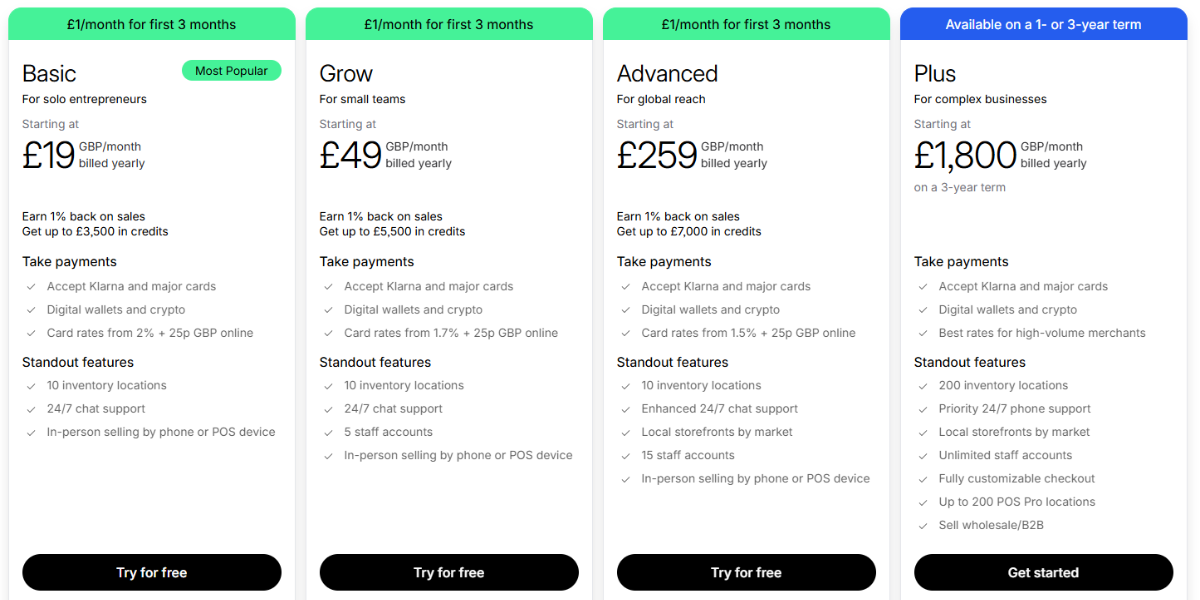
Note: Across all plans, Shopify’s pricing structure is designed to scale with your business. In most cases, upgrading becomes worthwhile when the cost savings, efficiency gains or revenue opportunities unlocked by a higher plan exceed the increase in monthly subscription fees.
This is one of the main reasons merchants choose to grow their business with Shopify, rather than replatforming as their store grows.
Sample Shopify Costs and Calculations by Business Type
One of the most common questions merchants ask is: “What is shopping actually going to cost me per month?” Now while exact costs will vary depending on factors such as sales volume, payment methods and apps, the examples below summarise these depending on the stage of your business.
Startup Business - £19 per month
Typical profile
- New ecommerce store or side business
- Low to moderate order volume
- Small product range
- Minimal reliance or need for paid apps
Likely Shopify setup
- Basic Shopify build
- Free or low-cost theme
- A small number of free or inexpensive apps
Monthly cost breakdown
- Shopify subscription fee
- Payment processing fees
- Optional apps
What to expect overall
- Low fixed-monthly costs
- No upfront platform fees
- Costs increase only as sales increase
Why Shopify works
Shopify keeps entry costs for startups predictable and avoids the technical overheads often associated with cheaper platforms. Most startup businesses can launch without custom development or long-term commitments, keeping costs low.
Growing Business - £49 per month
Typical profile
- Established ecommerce store
- Consistent monthly revenue
- Active marketing and ongoing optimisation
Likely Shopify status
- Shopify Grow tier
- Mix of paid apps
- Customised theme or some light development work
Monthly costs
- Shopify Grow subscription fee
- Reduced transaction and payment processing fees
- Moderate app spend
What to expect
- Higher base costs than a startup
- Better cost efficiency per order
- Improved reporting and operational control than Basic
Why Shopify works
At this stage, Shopify’s pricing scales sensibly, with lower fees and stronger reporting often offsetting the higher monthly subscription fee. This helps businesses grow without any sudden or unexpected jumps in cost.
Enterprise or high-volume business - £259/£1800 per month
Typical profile
- High order volumes
- International or multi-channel sales
- Complex workflows and integrations
Likely Shopify setup
- Advanced Shopify or Shopify Plus
- Custom integrations or bespoke apps
- Ongoing development and optimisation
Monthly costs
- Higher overall monthly cost
- Lower cost per transaction at scale
- Infrastructure designed to support long-term growth
Why Shopify works
For larger businesses, Shopify’s value lies in reliability, performance and scalability. Costs are predictable, and the platform can continue to grow alongside the business without the need to replatform as complexities increase.
Shopify Plan Breakdown
Basic Shopify Plan
The Basic Shopify plan is designed for merchants launching their first ecommerce store or running a small business online. It includes everything you need to sell online, manage products, process payments and fulfill orders without any unnecessary complexities.
Best for:
- Startups and solo founders
- Small product catalogs
Despite being the lowest-tier plan, Basic Shopify still delivers strong value when compared to alternative platforms that charge separately for things such as hosting, security and maintenance.
Shopify Grow Plan
The Shopify Grow plan is designed for businesses that are moving beyond early-stage ecommerce into sustainable growth. For many UK merchants, this plan provides the best balance of features, cost and scalability, which is why it’s often the most popular choice for those on Shopify. The Grow pan includes everything in Basic, plus a range of tools to help merchants operate more efficiently and optimise performance across the business as order volumes grow. Best for:
Growing ecommerce stores Businesses that are looking for deeper insight into performance
Advanced Shopify Plan
The Advanced Shopify plan is designed for high-growth businesses that rely heavily on data, automation and internationalisation. It offers the lowest transaction fees outside of Shopify Plus with advanced reporting and shipping features.
Best for:
- Scaling ecommerce brands
- International sellers
For a business at this stage, the reduced fees often offset the higher monthly subscription fees, making the Advanced plan a popular choice for rapidly growing businesses.
Shopify Plus
Shopify Plus is the solution for high-volume merchants processing large numbers of orders or running more complex ecommerce operations. Unlike standard plans, Shopify Plus uses variable pricing, which is typically based on the businesses requirements and revenue.
Best for:
- Large multi-functional operations
- International enterprises
For the right business, Shopify Plus offers exceptional performance, flexibility and the ability to scale once merchants have reached a suitable level.
Shopify Plus Pricing | How the Variable Fee works
Shopify Plus is designed for high-volume merchants with more complex operational requirements. Unlike standard Shopify plans, Plus does not have a fixed monthly price. Instead, pricing is variable and tailored to the needs of each business.
This model is designed for high-volume and enterprise-level merchants on the platform, and means that Shopify Plus pricing is based on revenue. Most businesses pay a minimum monthly platform fee, which then increases in line with sales performance as certain thresholds are reached. So rather than requiring a large upfront payment, this ensures that platform costs only increase alongside business growth.
For businesses operating at scale, the features included in Shopify Plus often replace the need for multiple third-party or custom-built solutions, so while there is a significant increase in monthly costs, technical overheads are typically reduced. Many enterprises find that the total cost of ownership is more manageable than maintaining a heavily customised platform elsewhere.
When Should I Upgrade My Shopify Plan?
Upgrading your Shopify plan is key to supporting your businesses' next stage of growth. Below is a clear, plan-by-plan guide to help merchants understand when an upgrade usually makes sense.
Basic Plan
For businesses in their earliest stages, the Basic plan keeps costs low and predictable. Most Shopify stores at this level rely on pre-built themes and standard functionality, with little or no custom development required. This makes build costs minimal and allows merchants to launch their stores quickly without significant upfront investment.
The total cost of ownership at this stage is driven primarily by transaction and payment fees rather than the Shopify subscription itself. As order volumes increase, these fees can begin to have a noticeable impact on margins. When this happens, upgrading is often less about accessing new features and more about improving overall cost efficiency.
Grow Plan
The Grow Plan is typically where ecommerce businesses begin to invest more intentionally in optimisation and performance. At this stage, merchants often introduce light customisation, improved user experience and a small number of paid apps to support marketing, fulfillment and customer retention.
Although the monthly subscription cost is higher than the Basic tier, the reduced transaction fees and more access to detailed reporting often offsets this increase for merchants. For growing businesses, this plan represents the most balanced option in terms of total cost of ownership, offering scalability without added unnecessary complexities.
Advanced Plan
As businesses scale further, operational complexity tends to increase,including things such as higher order volumes, international selling, multiple warehouses or more advanced reporting needs. The Advanced plan is designed to support this level of growth.
While subscription and build costs are higher at this stage, the lower transaction fees and access to advanced reporting and automation help businesses maintain control over their margins. For data-driven teams, these capabilities can deliver meaningful long-term value that outweighs the increased monthly platform costs.
Shopify Plus
For enterprise-level businesses, total cost of ownership is less about the direct monthly fee and more about reliability, scalability and long-term flexibility. Shopify Plus tier is typically chosen when standard plans no longer provide sufficient control over performance, integrations or operational workflows.
Although Shopify Plus is variable, it offers predictable infrastructure costs and removes many of the technical constraints associated with traditional enterprise platforms. For high-volume businesses, this often results in a lower cost-per order over time, even with the higher monthly platform fee.
Shopify vs Competitor Platforms
When choosing the right ecommerce platform, pricing and features are two of the most important considerations for merchants. Below, we’ve broken down how Shopify compares with other solutions, including pricing tiers, key features, ideal use cases and point of sale (POS) capabilities.
BigCommerce
Pricing
- BigCommerce typically offer tiered pricing plans comparable to Shopify, often with slightly different and sometimes higher limits on sales volume before requiring plan upgrades
- Annual discounts and enterprise options are available
Features
- Strong built-in features such as abandoned cart recovery, multi-currency support and advanced SEO tools
- Fewer third-party apps are needed because many capabilities are native.
Use Cases
- Best suited for businesses that are growing rapidly, and merchants who want powerful built-in functionalities without too much reliance on apps
- Good choice for merchants with complex product catalogues and B2B selling
POS Features
- BigCommerce integrates with select POS systems, but doesn’t offer a first-party POS solution as comprehensive as Shopify
- Suitable for businesses that already use a POS provider or prefer customised retail integrations
Adobe Commerce (Magento)
Pricing
- Adobe Commerce is open-source, but hosting, security and development costs on the platform can add up
- Enterprise editions carry high licensing fees
Features
- AC is exceptionally flexible and scalable, making it suitable for highly customised stores
- The extensive feature set includes advanced catalog management and global storefront capabilities
Use Cases
- Ideal for large enterprises or businesses with bespoke requirements and in-house technical support
- Not recommend for beginners due to complexities and development overheads
POS Features
- POS is typically enabled via third-party extensions rather than native tools
- Merchants can integrate with systems such as Lightspeed and other retail POS solutions, but the setup here is more complex than Shopify
Wix Ecommerce
Pricing
- Wix generally has lower startup costs than Shopify
- Ecommerce-specific plans are required to sell online
Features
- Extremely beginner-friendly with drag-and-drop design tools
- Best for small product catalogues and simple online stores
Use Cases
- Perfect for small businesses, creatives and beginners who are looking for ease over advanced commerce features
- Not ideal for large inventories or high-growth businesses
POS Features
- Wix integrates with select POS partners, but first-party POS capabilities are limited compared to Shopify
- Overall a good fit for smaller retailers with simple sales requirements
WooCommerce
Pricing
- Free plugin for Wordpress, but merchants need to pay for hosting, security and extensions
- Costs can fluctuate depending on selected plugins and theme purchases
Features
- Highly customisable with thousands of plugins and the flexibility of Wordpress
- Wide range of niche capabilities via extensions
Use Cases
- Best for WordPress users, bloggers expanding into commerce and stores that are looking for more granular control
- Requires more hands-on management than hosted platforms
POS Features
- POS functionality is available on the platform via plugins such as WooPOS or integrations such as Square
- Not native, which means setup and maintenance depend on third-party tools
Shift4Shop
Pricing
- Pricing is competitive with built-in features
- Transparent and predictable tier structure making it easy for merchants to select what suits their needs
Features
- Strong set of native ecommerce tools, including marketing, SEO and product management
- Less dependent on costly add-ons
Use Cases
- Good choice for small to midsize merchants looking for a full feature seat without high monthly fees
- Particularly appealing for merchants open to using Shift4 payment
POS Features
- Shift4Shop offers integrations with retail POS systems, allowing syncing in-store and online
- Ecosystem solid but generally not as deep as Shopify’s out-of-the-box solution
What Each Shopify Plan Works Best For
Choosing the right Shopify plan depends on your current stage of business, your sales volume, and how complex your operations are overall. Below we’ve broken down who each plan is best suited for, the key features and when it might be time to upgrade.
Basic Plan - Ideal for Startups and Solo Merchants
The Basic Shopify plan is ideal for new businesses launching their first online store, as it provides everything you need to sell online, process payments, manage inventory, and ship products, all without overwhelming advanced features that may not be needed yet.
This plan is best suited for
- Startups testing a new product or idea
- Solo entrepreneurs
- Businesses with low to moderate monthly sales volume
- Sellers operating primarily online
With competitive transaction fees and access to Shopify’s core e-commerce tools, Basic allows you to focus on growth without high overhead costs.
Grow (Shopify) – Best for Growing Small Businesses Who Plan To Scale
The Grow Shopify plan (previously known as the standard plan) is designed for businesses that are gaining traction quickly and need more professional tools to support expansion.
The Grow plan is ideal for:
- Growing online stores with consistent monthly revenue
- Small teams needing multiple staff accounts
- Brands that are expanding into international markets
- Businesses that rely on data to guide decisions
With improved reporting, lower transaction fees than Basic, and additional staff accounts, Grow supports businesses transitioning from startup levels to established businesses.
Advanced – For Large Established, High-Volume Stores
The Advanced Shopify plan is built for businesses experiencing significant growth and higher transaction volumes. The Advanced plan offers lower payment processing fees and more advanced reporting capabilities.
This plan works best for
- Established brands with high monthly revenue
- Businesses looking for custom reporting
- Larger teams managing complex operations
The reduced transaction fees alone can make this plan cost-effective for higher-volume stores. Merchants have access to advanced reporting tools which can be useful with forecasting, tax management, and operational efficiency.
Shopify Plus – Enterprise-Level Commerce Stores
Shopify Plus is the platform's enterprise solution, designed for high-growth and high-volume businesses that require maximum flexibility, automation, and scalability.
It’s best suited for
- Global brands operating in multiple markets
- High-revenue businesses
- B2B and wholesale sellers
- Brands that require custom checkout experiences
Shopify Plus includes advanced API access, custom checkout capabilities, automation tools, priority support, and enhanced B2B functionality. It is typically offered on longer-term contracts and tailored to each individual business requirements.
Sample Cost Calculations
While Shopify’s subscription pricing is transparent, total monthly costs depend on how your business operates, for example sales volume, payment methods and development needs.
In the examples below, we’ve highlighted some illustrative scenarios designed to show you how costs typically scale at different stages of growth.
Startup Business
Imagine a small UK startup launching a direct-to-consumer skincare brand. The business has less than 20 products, manages fulfillment in house and processes a small number of monthly orders.
In this case, the merchant would typically use the Shopify Basic plan. Their core monthly cost would include the subscription fee plus payment processing charges based on revenue. App usage would likely be minimal, and because order volume is relatively low, transaction fees represent the largest variable cost.
However, overall platform expenses are predictable and directly tied to sales performance. At this stage, Shopify provides professional infrastructure without requiring custom development or technical maintenance, keeping the total cost of ownership accessible for a founder at the early stage.
Growing Business
Next, consider an established fashion brand generating consistent monthly revenue and investing in paid advertising. The business has expanded its product catalogue, introduced bundles and promotions and wants deeper reporting on customer behaviour.
This merchant would likely move to the Grow tier, and while the subscription cost is higher, lower transaction fees would improve margin efficiency as order volumes increase. The business may also be interested in paid apps for marketing automation, and subscriptions.
Total monthly platform costs in this case are higher in absolute terms when compared to a startup, however, the cost per order often decreases due to lower payment processing rates and improved operational efficiency.
Enterprise Business
Finally, at the enterprise level the structure changes again. Consider a global cosmetics brand such as Kylie Cosmetics, which operates across multiple regions, manages high traffic volumes and launches time sensitive product drops.
A business of this scale would typically operate on Shopify Plus, where pricing is based on revenue and flexibility. While monthly costs are higher than other plans, transaction rates are lower and infrastructure is built to handle operating at scale.
Key Takeaway
Across all three of these scenarios, Shopify’s pricing model follows a consistent logic, where cost increases in line with revenue and complexity. For most businesses, this makes budgeting simpler and growth more manageable.
Rather than forcing businesses to invest heavily in upfront commitments, Shopify allows merchants to scale gradually and upgrade plans when commercial benefits begin to outweigh the additional costs.
Additional Costs To Consider
Basic
Build costs: At basic level, build costs are typically minimal. Most startups launch using a pre-designed theme with light configuration rather than bespoke development.
Agency pricing: Not typically complex, any involvement at this level is usually project-based. Many businesses may decide on initial setup support, light customisation or technical guidance rather than ongoing retainers.
Total cost of ownership: Now mostly driven by transaction and payment fees rather than development work, and while subscription fees are low, higher transaction rates may impact margins as revenue grows. For early-stage businesses however, Basic remains one of the most accessible entry points into the ecommerce landscape.
Grow
Build costs: Grow businesses often invest more in user experience and optimisation. This may include modern theme customisation, performance improvements and small development projects designed to increase conversion rate.
Agency pricing: At this stage, many merchants move towards ongoing agency support. This may involve a monthly retainer focusing on marketing, CRO or small technical improvements. Costs are higher than Basic but usually align with realistic revenue growth.
Total cost of ownership: Subscription fees increase, but reduced transaction costs and stronger reporting tools can improve overall efficiency. For many businesses, the Grow plan offers the most balanced long-term option when it comes to cost vs capability.
Advanced
Build costs: These stores are more likely to require bespoke integrations, international configurations and complex workflows, meaning the cost increases depending on operational needs.
Agency pricing: At this stage, there will be more strategic involvement, with ongoing technical development, system integrations, international expansion and performance optimisation.
Total cost of ownership: While monthly subscription fees are higher, lower transaction costs and enhanced reporting help protect margins at scale with Advanced. For data-driven merchants, the improved insight and automation offered justified the higher cost.
Shopify Plus
Build costs: May involve custom storefronts, advanced integrations and performance-focused architectures, initial investment is higher. But designed to support at scale without the need to replatform.
Agency pricing: At this level, agency partnerships are usually strategic and long-term, with merchants requiring continuous optimisation, marketing and international rollout support.
Total cost of ownership: Although Plus operates on a variable pricing mode, the infrastructure, scalability and support reduces the need for extensive in-house technical maintenance. For high-level businesses, cost per order often decreases over time, making total cost of ownership more predictable than traditional platforms.
Summary
Shopify offers a range of pricing plans designed to support businesses at every stage of growth, from startups to fully-scaled enterprises. Understanding which plan is right for you depends on factors such as sales volume, feature requirements and how you plan to grow your business over time.
Not sure which plan or setup is right for your stage of growth? Our Discovery Audit gives you an objective view of your current store performance and makes a clear recommendation on where to invest next.
Last updated: February 2026. Prices sourced from Shopify.com and verified against current plan pages. Shopify pricing is subject to change — always check the official Shopify pricing page for the latest figures.