



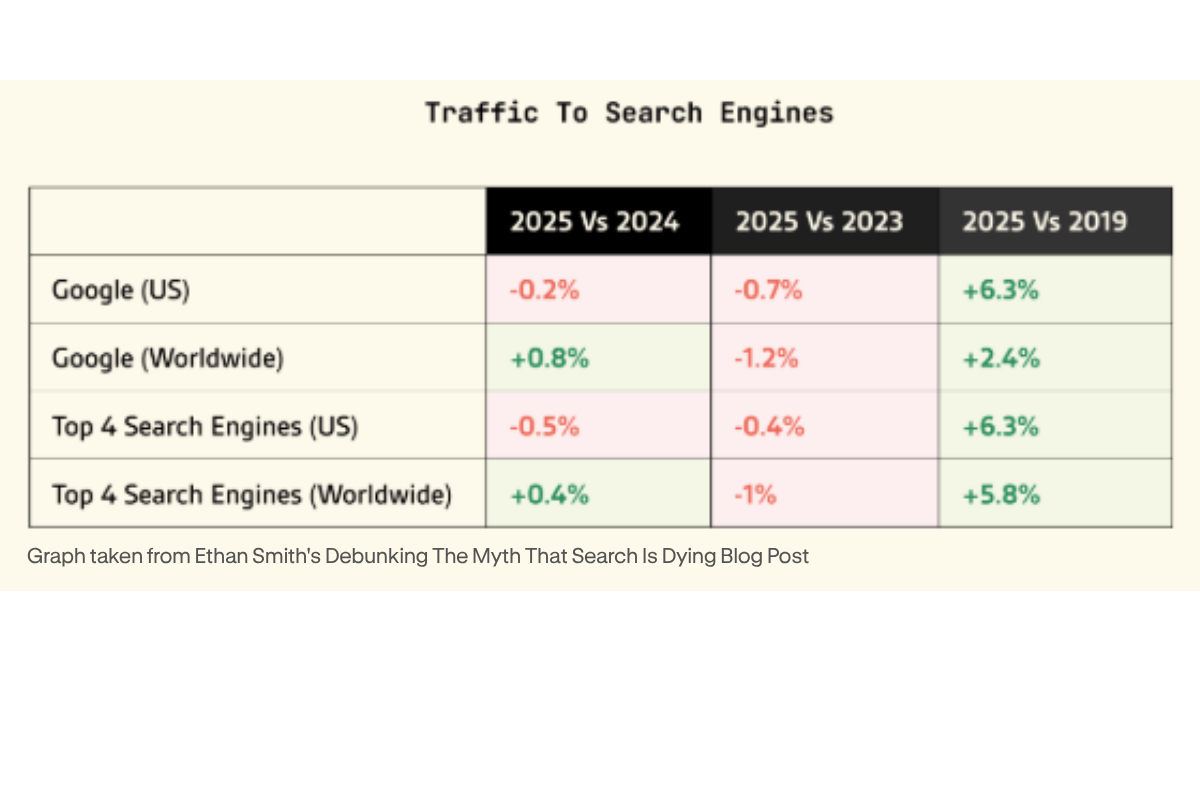
Every few months, a new wave of content predicts the death of search. AI is taking over. Organic traffic is finished. It makes for a good LinkedIn debate, but it doesn't hold up when you look at the actual data.
Search is not dying (just yet). For a lot of ecommerce brands, it remains the single largest source of qualified traffic on the internet. What has changed is the conversation around it, and that distinction matters a great deal if you're deciding where to invest.
The Numbers Nobody Is Talking About
Rand Fishkin recently published research analysing the top 5,000 most-visited websites on the web. The finding that should stop you in your tracks: Google is as large as the next 13 most-visited sites combined. Not the next two or three. Thirteen.
That is not a channel in decline. That is a channel so dominant that most people cannot conceptualise its actual scale. Yet somehow the prevailing narrative has drifted towards "Google is losing ground." It is worth asking who that narrative serves, and whether the data actually supports it.
Where Your Customer Actually Searches
The more useful question is not whether Search is alive. It is whether your brand shows up wherever your customer goes looking. And your customer goes looking in more places than you might think.
People search on Amazon before they buy. They search YouTube before they commit. They search Reddit when they want an honest opinion from someone with nothing to sell. Google sits at the centre of that ecosystem, but it does not own it entirely. The brands that treat search as a single destination rather than a pattern of behaviour running across the whole web are leaving visibility on the table.
That visibility gap shows up in the buyer journey in ways that are easy to miss. Third-party discussions, category-level comparisons, and community forums are increasingly where buyers form their first impressions, often before they have visited a single brand website. By the time someone lands on your product page, they may have already decided how credible you are based on what they found elsewhere. If those conversations are happening without you, that is a problem no amount of on-site optimisation will fix.
The Problem with "Just Optimise for AI"
The temptation right now is to pivot hard towards AI search and treat organic as yesterday's problem. That is the wrong call. Consider what happens when a brand's strongest proof points exist only internally, locked in customer calls, internal decks, or a founder's head. AI systems do not have access to any of that. They build their picture of your brand from whatever public evidence exists. If that evidence is thin or inconsistent, AI tools will piece together whatever they can find, and the picture they paint may not be the one you would choose. Brands that have published clear, credible, specific information about what they do and why they are good at it are the ones AI systems cite with confidence.
This applies directly to ecommerce. If your product pages are vague, your reviews sparse, and your brand presence patchy across the web, no amount of AI optimisation will save you. The public record is the raw material that both Google and AI systems work from.
What This Actually Means for Your Shopify Store
The brands that will win over the next two to three years are not the ones that abandon organic search for AI, or vice versa. They are the ones that understand these two things reinforce each other.
A strong SEO foundation, technically clean pages, authoritative content, structured data, and consistent brand signals across the web, is exactly what makes you visible in AI search too. Google AI Overviews draw from Google's existing index. Perplexity crawls the open web. ChatGPT's browse feature pulls real-time results. The brands that appear in those AI answers are almost always the brands that already had strong organic presence.
Generative Engine Optimisation (GEO) is the discipline that sits on top of that foundation. It is about structuring your content so that AI systems can parse, trust, and cite it. Specific product specifications rather than vague marketing copy. FAQ content that matches the questions people actually ask. Review schema that makes your ratings machine-readable. Consistent brand information across every platform an AI might cross-reference. For a full breakdown of how to approach GEO for your Shopify store, this guide covers it in detail.
GEO and SEO are not competing priorities. Getting good at one makes you better at the other. Brands that treat them as separate bets are splitting effort that should be compounding.
Another term, often quoted by Rand Fishkin, is Search Everywhere Optimization, which encapsulates work done for SEO and GEO. In essence, optimise for where your visitors will be searching throughout their journey.
The Actual Risk
The risk for ecommerce brands right now is not that search becomes irrelevant. It is that the noise around AI causes brands to underinvest in the organic foundations that underpin everything else, just as the standards for what constitutes a credible search presence are rising.
Organic search is still where the volume is. AI search is where the growth is. The brands paying attention to both, building real authority, publishing real evidence, and showing up credibly across the full landscape of where their customers are looking, are the ones that will compound their advantage over the next few years.
Everything else is just waiting to be disrupted.
Eastside is a Platinum Shopify Partner helping ambitious ecommerce brands build stronger stores and smarter marketing strategies. If you want to understand where your brand stands across organic and AI search, get in touch.