

Beauty is one of the most competitive categories on Shopify, and also one of the most instructive. The brands that win are rarely the ones with the biggest ad budgets. They are the ones that have worked out how to turn a first-time visitor into a repeat customer, and they leave clues all over their storefronts about how they do it. We pulled apart 22 of the best health, beauty and cosmetics stores running on Shopify to show you what those clues are and which of them are worth copying.
Is selling beauty on Shopify worth it?
For most beauty and wellness brands, yes. Margins in the category are healthy, the products photograph well, and the buying decision is emotional enough that strong branding genuinely moves the needle. Shopify suits all of that. It handles the spikes that come with a product drop or an influencer post without falling over, it scales from a first-year startup to a brand turning over tens of millions, and its app ecosystem covers almost everything a growing beauty brand needs, from subscriptions and loyalty to shade finders and quizzes.
What it will not do is rescue a weak proposition. The stores below succeed because they pair the platform with a clear point of view, disciplined merchandising and a reason to come back. That combination is the thing to study, not the logo in the footer.
A quick note on the list. We have kept it to brands currently trading on Shopify or Shopify Plus, and we have left out a few celebrity lines that have since closed or moved off the platform. Where revenue is publicly reported we have cited it. Plenty of these businesses are privately held and do not publish figures, and we have said so rather than invent a number.
22 health, beauty and cosmetics brands on Shopify
1. Rhode
Rhode is the clearest recent proof that restraint sells. Hailey Bieber launched it in 2022 with a deliberately tiny range, and the store reflects that discipline: a lot of white space, a handful of hero products, and product pages that lead with what each one does rather than burying it under marketing copy. The scarcity is real too, with launches that sell through and a waitlist mechanic that builds demand before anything goes live.
The numbers make the point. Rhode generated $212 million in net sales in the 12 months to March 2025 from only ten products sold direct, and e.l.f. Beauty acquired it that May in a deal worth up to $1 billion. The lesson for a smaller brand is that a tightly edited catalogue, where every product earns its place, can outperform a sprawling one.
Worth stealing: lead product pages with the benefit, keep the range deliberately small, and use waitlists to turn a launch into an event.
2. Rare Beauty
Rare Beauty has built one of the strongest emotional connections of any brand on this list, and the store carries that through without getting in the way of the sale. Selena Gomez's mission around mental health and inclusivity sits alongside shade-matching help, tutorials and heavy use of customer reviews, so the values and the practical shopping tools reinforce each other rather than compete.
It is also a commercial heavyweight. Forbes reported Rare Beauty at $367 million in revenue in 2023 across direct and retail. If you take one thing from it, make it the way the brand story is woven into the shopping experience instead of being quarantined on a separate "about" page.
Worth stealing: put your values where people are already shopping, and back them with reviews and education rather than slogans.
3. e.l.f. Cosmetics
e.l.f. is the case study in making affordability feel exciting rather than cheap. The store is bright and easy to move around, promotions are never more than a click away, and trend-led products are pushed hard on the homepage. Educational content does the quiet work of giving first-time buyers the confidence to add to basket.
As a listed company, e.l.f. reports its numbers, and they are substantial: revenue reached $1.3 billion in its 2025 financial year, having roughly doubled over the previous two. The takeaway is that a value brand does not have to look like one. Strong merchandising and a frictionless path to checkout let e.l.f. trade on energy, not just price.
Worth stealing: surface promotions and trending products immediately, and use how-to content to reduce hesitation at the point of sale.
4. Fenty Beauty
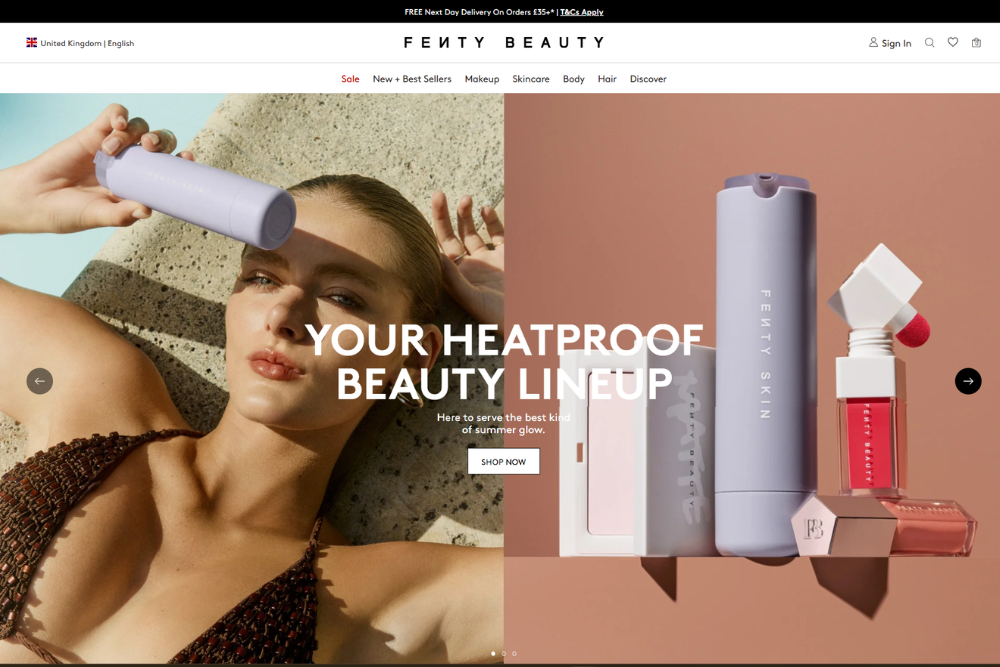
Fenty changed the category with its original 40-shade foundation range, and the store is built to make that breadth shoppable. Shade finders and rich imagery take the guesswork out of buying complexion products online, which is one of the hardest things to get right in beauty ecommerce. Inclusivity is not a banner here, it is designed into the tools.
Rihanna's brand, a joint venture with LVMH, does not publish standalone accounts, though it is consistently reported among the largest celebrity beauty lines in the world. The practical lesson is about removing uncertainty: if a customer can find their exact shade in a few taps, they are far more likely to buy and far less likely to return the order.
Worth stealing: invest in interactive buying tools for any product where "will it suit me" is the blocker to purchase.
5. Glow Recipe
Glow Recipe turns a fruit-led skincare concept into a store with genuine personality. Bold colour, playful product naming and a heavy dose of user-generated content make it feel approachable, while product pages packed with reviews, routines and ingredient explainers keep it credible. It is a good example of a brand that is fun without sacrificing trust.
The brand is privately held and does not disclose revenue, but it sells through its own Shopify store alongside major retail partners and has become one of the more recognisable names in modern skincare. The detail worth borrowing is how it groups individual products into routines, which lifts average order value by making the next purchase obvious.
Worth stealing: bundle products into routines so the customer buys the system, not the single item.
6. The Ordinary
The Ordinary made its name by stripping skincare back to ingredients and prices, and the store mirrors that honesty. Plain packaging, clear categorisation and detailed ingredient information let customers build a routine without wading through marketing claims. Transparency is the entire proposition, and the site is designed to deliver it quickly.
It now sits within Estée Lauder's portfolio, after the group completed its $1.7 billion acquisition of parent company Deciem, and remains one of the most recognisable skincare brands globally. For brands in a complicated or jargon-heavy category, it is the model: educate first, sell second, and let the clarity do the persuading.
Worth stealing: in a confusing category, win on transparency. Explain the product properly and trust the customer to decide.
7. Medicube
Medicube pairs science-led skincare with at-home beauty devices, and its store does a lot of careful work to make that range navigable. Products are organised by skin concern, devices sit alongside the routines they support, and before-and-after imagery does the heavy lifting on proof. The clinical positioning comes through in the design without locking out a first-time shopper.
It is one of the fastest-growing K-beauty brands internationally, though as a privately held business it does not publish detailed figures. What is easy to replicate is the navigation logic. Letting people shop by the problem they want to solve, rather than by product type, shortens the route from landing to purchase.
Worth stealing: organise the store by customer concern, and use before-and-after content as your primary trust signal.
8. Kylie Cosmetics
Kylie Cosmetics remains one of the most-cited Shopify Plus stores for a reason: it turned a single founder's audience into a launch machine. The store is built around drops, countdowns and limited editions, with premium imagery and a checkout streamlined to survive the traffic spikes those launches create. Shopify reportedly had to write custom software to manage the queues in the early days.
The brand, now majority-owned by Coty, was reported at around £500 million in turnover in 2024. You do not need a celebrity following to use the underlying mechanic. Building anticipation ahead of a release, then making the purchase itself effortless, works at any scale.
Worth stealing: engineer anticipation before a launch with countdowns and limited runs, then make sure your checkout can take the surge.
9. ColourPop
ColourPop is built for speed. New launches and collaborations land constantly, and the store is set up to keep the catalogue easy to browse despite the pace. Featured products and bundles are refreshed often, which gives regulars a reason to keep checking back and keeps the homepage from going stale.
It is one of the most successful digitally native cosmetics brands, and like most of its peers keeps revenue private. The habit worth copying is the cadence. A homepage that changes regularly, with limited releases creating gentle urgency, trains customers to return rather than wait to be retargeted.
Worth stealing: refresh featured products frequently so repeat visitors always find something new.
10. Hismile
Hismile took an unglamorous category, oral care, and made it shareable. The store leans on bold branding, product demonstrations and heavy social proof, and its landing pages are clearly built with paid traffic in mind, matching the ad that brought you there and pushing one clear action. It is a masterclass in conversion-focused design for a brand that lives on social.
The scale is real: an Ivey and Bond University case study put Hismile at A$700 million in gross sales in 2024, built without outside investment. The most portable idea is the tight match between ad and landing page, which is where a lot of paid budget quietly leaks away.
Worth stealing: build dedicated landing pages that mirror your ads, and use demonstration video to sell a product people need to see working.
11. Morphe
Morphe grew up alongside the creator economy, and its store still trades on that heritage. Themed collections, creator collaborations and bold visuals keep it feeling current, and the homepage is refreshed often to highlight new arrivals and partnerships. It is a brand that understands its audience comes back for the next thing, not just the last one.
Revenue is not publicly broken out, but the merchandising approach is widely studied. The transferable part is matching collaborators to your actual audience rather than chasing the biggest name, so the partnership feels native instead of bolted on.
Worth stealing: partner with creators your customers already follow, and theme collections so each drop has a clear hook.
12. Tropic Skincare
Tropic Skincare combines natural, sustainability-led messaging with a polished store and a consultant network behind it. Ingredient education and transparency around sourcing are front and centre, which is exactly what its audience is buying into. The values and the commercial mechanics are well aligned, and neither feels like an afterthought.
One of the UK's larger independent skincare brands, Tropic keeps its figures private. The lesson for any purpose-led brand is specificity. Vague claims about being "natural" do little, but clear, evidenced detail about ingredients and sourcing builds the trust that converts.
Worth stealing: make sustainability claims concrete and evidenced. Specifics build trust, generalities erode it.
13. Beardbrand
Beardbrand is the clearest example here of content turning a product company into a brand. It started as a grooming line and grew into a lifestyle identity, with storytelling and education doing as much work as the products themselves. Subscriptions and curated sets then turn that engaged audience into recurring revenue.
The business is privately held, but its approach is well documented. The takeaway is that authority is a moat. Becoming the most useful voice in your niche makes you hard to copy in a way that a product range alone never will.
Worth stealing: build authority with genuinely useful content, then use subscriptions to turn that audience into lifetime value.
14. Beard & Blade
Beard & Blade shows how far a sharply defined niche can take you. It serves men's grooming with a curated range, strong filtering and educational content that helps a customer move from beard oils to shaving kit without friction. Knowing exactly who it is for makes every merchandising decision easier.
As a specialist retailer it keeps revenue private, but the model is instructive. Detailed product information and good on-site filtering reduce the hesitation that kills conversion in considered categories, and they encourage the repeat business that niche audiences are loyal enough to give.
Worth stealing: serve a well-defined audience properly, and let filtering plus detailed product info carry the considered purchase.
15. Pixi Beauty
Pixi pairs soft, consistent branding with practical content, and the balance is the point. Tutorials, ingredient detail and customer reviews sit alongside aspirational imagery, so the store inspires and reassures at the same time. Hero products are given room to stand out rather than being lost in the range.
An internationally recognised brand with both direct and retail sales, Pixi does not disclose figures. The detail worth borrowing is the buying guide. Helping customers understand what to pick, and why, removes a quiet barrier that flat product grids leave in place.
Worth stealing: give hero products space, and add buying guides that help customers choose with confidence.
16. True Botanicals
True Botanicals sells premium, clean skincare and uses credibility as its main lever. Expert endorsements, clinical detail and rich lifestyle imagery combine to justify the price point, while subscriptions and bundles encourage replenishment. It is a careful balance of aspiration and evidence, and the store keeps both in view.
A well-established player in premium skincare, the brand keeps revenue private. For any premium proposition, the model holds: pair the storytelling with hard proof, because at higher price points customers need a reason to believe as well as a reason to want.
Worth stealing: at a premium price, back the aspiration with clinical proof and expert endorsement, and offer subscriptions for replenishables.
17. Ilia Beauty
ILIA blends a luxury clean-beauty aesthetic with tools that make shopping easier. Quizzes and shade-matching guide customers to the right products, while editorial content around ingredients and sustainability builds the trust the positioning depends on. The sophisticated look never gets in the way of finding what you came for.
One of the leading clean-beauty brands, ILIA sells direct and through retail partners and does not publish figures. The reusable idea is personalisation through quizzes, which reduces choice paralysis and quietly raises conversion by making the decision feel made-for-me.
Worth stealing: use quizzes and recommendation tools to cut choice paralysis and personalise the path to purchase.
18. Absolute Collagen
Absolute Collagen is built around a simple proposition and a strong subscription model, which is exactly right for a consumable supplement. Testimonials, before-and-after content and clear benefit messaging make the product easy to understand, and the store is set up to convert that understanding into a recurring order rather than a one-off.
It is one of the UK's leading collagen brands, and we have worked with the team ourselves. You can read more in our Absolute Collagen client story. The principle to take away is that for anything consumable, retention matters as much as acquisition, and subscription is the mechanism that captures it.
Worth stealing: for consumable products, design around subscription from the start and use real customer stories to prove the benefit.
19. Summer Fridays
Summer Fridays looks the part and shops cleanly with it. Large editorial imagery and subtle animation create an aspirational feel, but navigation stays simple, so bestsellers and new launches are never more than a click away. Product pages are rich with imagery, ingredient detail and reviews, which keeps the premium look grounded in useful information.
The brand is reported to turn over well into the tens of millions and continues to expand internationally, though it does not publish exact accounts. The balance is the lesson: editorial styling earns attention, but it only converts when the practical detail sits right behind it.
Worth stealing: let editorial imagery set the tone, but keep navigation simple and product detail thorough underneath it.
20. White Rabbit Skincare
White Rabbit Skincare shows how a smaller independent competes on positioning rather than budget. The store centres on ethical, vegan and cruelty-free skincare, with soft branding and clear messaging that speak directly to conscious shoppers. Certifications and detailed product pages do the trust-building work that a big ad spend would otherwise have to.
As an independent retailer it keeps figures private, but the approach is exactly what smaller brands should study. Strong positioning and visible trust signals let a focused store punch well above its size against far larger competitors.
Worth stealing: compete on a sharp position and visible trust signals, not on budget. Certifications and detail do real persuading.
21. Ouai
Ouai brings a luxury haircare feel to a store that still guides you efficiently. Lifestyle imagery and educational content sit alongside personalised recommendations and hair-type guidance, so the experience feels aspirational while quietly steering customers to the right products. The brand personality is consistent on every page.
Ouai has grown into a globally recognised haircare name, with industry estimates putting annual revenue above $100 million across direct and retail, though it does not publish formal accounts. The reusable detail is the hair-type guidance, which is personalisation that genuinely helps the customer rather than personalisation for its own sake.
Worth stealing: use recommendation tools that solve a real customer question, and keep brand personality consistent across every page.
22. The Beauty Crop
The Beauty Crop rounds out the list as a smaller brand getting the fundamentals right. Playful branding, bright colour and influencer-led content create an engaging journey aimed squarely at younger beauty shoppers, and bestsellers are featured prominently so newcomers know where to start. Navigation is kept simple and mobile-first, which matters for an audience that arrives mostly from social.
It runs a global direct-to-consumer business and, like most independents here, keeps revenue private. The takeaway is that a distinctive identity, clearly merchandised, is enough to stand out even without a large budget behind it.
Worth stealing: commit to a distinctive visual identity and feature your bestsellers up front for first-time visitors arriving from social.
What the best beauty stores have in common
Read across all 22 and the same handful of decisions keep recurring. None of them is exotic, and that is the point. The brands that win in beauty execute the fundamentals more consistently than everyone else.
- A tightly edited range, where every product has a clear job, beats a sprawling catalogue. Rhode built a $212 million business on ten products.
- Education sits next to the buy button, not on a separate page. The Ordinary and Medicube both turn explanation into conversion.
- Products are grouped into routines or bundles, which lifts average order value by making the next purchase obvious.
- Buying tools, such as shade finders and quizzes, remove the "will it suit me" hesitation that kills conversion in beauty.
- Subscriptions are designed in for anything consumable, because retention matters as much as acquisition.
- Landing pages match the ads that feed them, so paid budget converts instead of leaking.
What does not appear on that list is a magic app or a single growth hack. Performance comes from the combination: a clear proposition, disciplined merchandising, the right technical foundations and a reason to come back.
How Eastside helps beauty brands grow
We are a Shopify Plus partner agency, and beauty is one of the categories we know best. The brands above show what good looks like. Getting there is a matter of building the right store and then improving it methodically, which is the work we do every day.
On the build side, our Shopify design and development teams create stores that carry a brand's identity without sacrificing the path to checkout. If you are coming from another platform, we handle Shopify migration end to end. Once a store is live, our SEO and ecommerce marketing teams work on the traffic and the conversion rate together, because growth needs both.
If you are not sure where the biggest gains are, a discovery audit is usually the right place to start. We look at the whole store and tell you, plainly, what is working and what is holding it back. When you are ready to talk, get in touch.
Final thought
The brands on this list range from billion-dollar acquisitions to focused independents, and they do not share a budget or a category. What they share is execution. Each one has decided who it is for, edited its range accordingly, made the proposition easy to understand and given customers a reason to return.
That is the encouraging part, because none of it is reserved for the brands with the most money. Pick the handful of moves above that fit your business, apply them properly, and the platform will support the rest.
For further inspiration on how to make your Shopify store successful, we recommend checking out our latest article to discover more of the biggest names and brands using Shopify.
We have also put together a list of the best Shopify Jewellery stores, best Clothing and Fashion brands Shopify and best Food and Drink brands using Shopify, take a look!